Hazel Avenue Prospect Avenue Historic District

Why it's listed
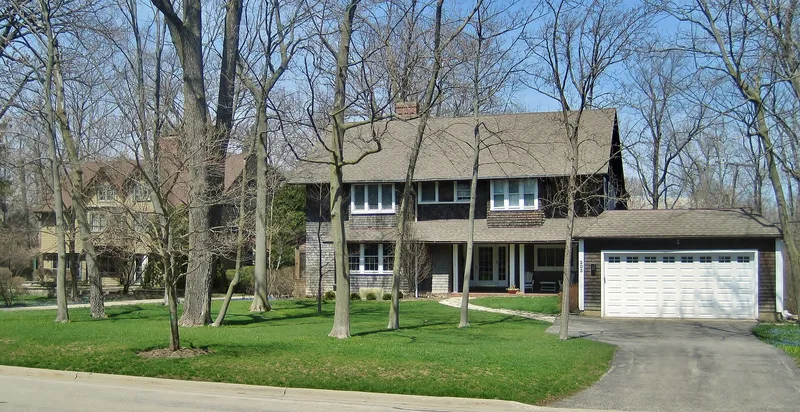
Hazel Avenue and Prospect Avenue in Highland Park, Illinois, form a district of about 50 acres that gathers some of the city's oldest buildings. Its houses range from the 1847 Stupey log cabin, the oldest standing structure in town, to Victorian mansard and Queen Anne homes of the 1870s to 1890s, shingle houses attributed to Howard Van Doren Shaw, and Colonial Revival and French Provincial houses of the 1920s. Inventor Elisha Gray, who filed a telephone patent on the same day as Alexander Graham Bell, lived at 461 Hazel and worked in a nearby cottage at 333 Hazel. The Wildwood compound, built as a summer residence for Hyde Park families, reflects the area's days as a resort community. Civic buildings, including the 1930 limestone City Hall and the 1931 Tudor-style public library, anchor the western edge. Together the buildings illustrate the home styles typical of the years 1870 to 1930.
Machine-generated summary. This summary was generated by a language model from the official nomination document and has not been reviewed line by line by an editor. It may contain errors. Check the source document before relying on any detail. Source: nomination document (PDF) · catalog entry. Generated October 2026 (model claude-sonnet-5-5, prompt v1.0-2026-10-29).
| Styles | Victorian (French Mansard, Queen Anne, Carpenter Gothic), Shingle Style, Arts and Crafts, Colonial Revival, Classical Revival, Tudor, French Provincial |
|---|---|
| Areas of significance | Architecture |
| Acreage | 50 |
| Boundary source | NPS cultural-resource GIS polygon |
| Full listing page | Hazel Avenue Prospect Avenue Historic District (property record) |
What listing means for this property
This is a historic district. Buildings within its boundary are either contributing (they add to the district's significance) or non-contributing. Owners of contributing income-producing buildings can claim the 20% federal rehabilitation tax credit; homeowners should look at state credits. National Register districts impose no design review by themselves; a local historic district ordinance, if one exists, does (the difference explained).
General information, not legal or tax advice. Rules change; confirm with your State Historic Preservation Office or a qualified adviser.