Grant Park

Why it's listed
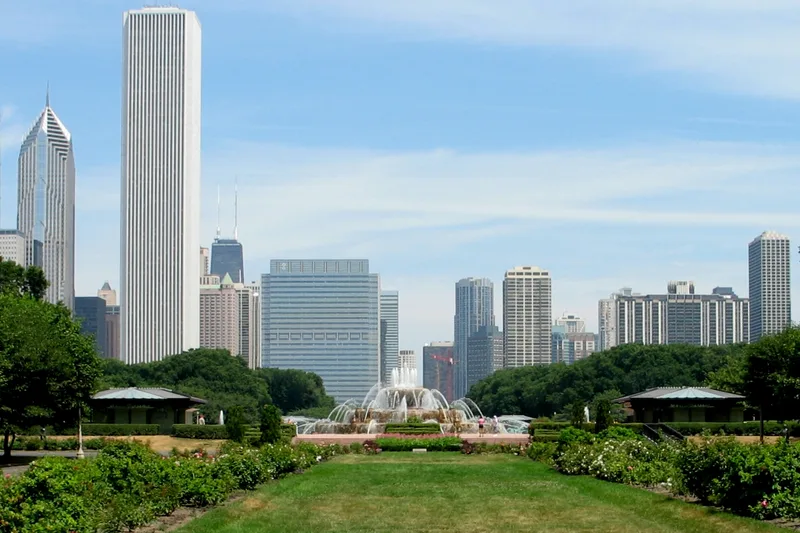
Grant Park is a 319-acre lakefront park on Lake Michigan, just east of Chicago's Loop. Although the land is among the city's oldest public ground, its formal design took shape from the mid-1890s and most of it was built in the late 1920s and 1930s. Successive plans, from P.B. Wight to Edward Bennett and the South Park Commission, followed French garden precedent: symmetrical spaces, rows of trees, recessed lawn panels, fountains, terraces and sculpture, with Art Deco details added. Two main axes run through the park, one east-west through Buckingham Fountain. Features include the Beaux-Arts Art Institute building with its bronze lions, a two-level Michigan Avenue promenade with ornamental concrete rostral columns, the Logan Memorial, the Rosenberg Fountain, and Ivan Mestrovic's mounted Indian sculptures at the Congress Drive entrance. Changes include the 1953 garage built beneath the northern promenade and the 1955 Congress Drive widening, yet the nomination holds that the overall design retains its integrity.
Machine-generated summary. This summary was generated by a language model from the official nomination document and has not been reviewed line by line by an editor. It may contain errors. Check the source document before relying on any detail. Source: nomination document (PDF) · catalog entry. Generated October 2026 (model claude-sonnet-5-5, prompt v1.0-2026-10-29).
| Styles | Late 19th and 20th Century Revivals/Beaux Arts; Modern Movement/Art Deco |
|---|---|
| Areas of significance | Landscape Architecture, Entertainment/Recreation, Architecture, Social History |
| Acreage | 319 |
| Boundary source | NPS cultural-resource GIS polygon |
| Full listing page | Grant Park (property record) |
What listing means for this property
This is a historic district. Buildings within its boundary are either contributing (they add to the district's significance) or non-contributing. Owners of contributing income-producing buildings can claim the 20% federal rehabilitation tax credit; homeowners should look at state credits. National Register districts impose no design review by themselves; a local historic district ordinance, if one exists, does (the difference explained).
General information, not legal or tax advice. Rules change; confirm with your State Historic Preservation Office or a qualified adviser.