East Ravenswood Historic District

Why it's listed
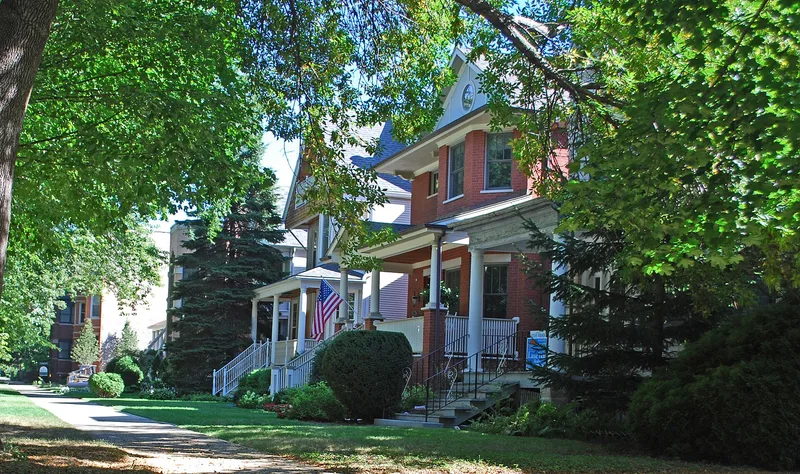
East Ravenswood is a neighborhood of about 1,700 buildings on Chicago's north side, roughly six miles north of the Loop, bounded by Lawrence, Clark, Irving Park and Ravenswood. Most buildings date from 1880 to 1929 and stand two or three stories tall, often on raised basements. Frame cottages and larger houses sit alongside brick two-, four- and six-flats, courtyard apartment buildings and corridor apartment buildings, many decorated with limestone trim and terra cotta. The area grew from the 1868 Ravenswood subdivision. After the 1871 fire, working-class and wealthier families moved there, drawn by cheaper wood-frame construction and distance from the city. Growth continued with streetcars, rail service, annexation to Chicago in 1889 and the extension of the elevated line in 1901. A light-industrial corridor along the railroad tracks and Ravenswood Avenue, together with commercial streets and many schools and churches, shows how the community developed. Its uniform scale and range of building types and styles make the district cohesive.
Machine-generated summary. This summary was generated by a language model from the official nomination document and has not been reviewed line by line by an editor. It may contain errors. Check the source document before relying on any detail. Source: nomination document (PDF) · catalog entry. Generated October 2026 (model claude-sonnet-5-5, prompt v1.0-2026-10-29).
| Styles | Queen Anne, Neo-classical Revival, Bungalow/Craftsman |
|---|---|
| Areas of significance | Community Planning and Development, Architecture |
| Acreage | 247 |
| Boundary source | NPS cultural-resource GIS polygon |
| Full listing page | East Ravenswood Historic District (property record) |
What listing means for this property
This is a historic district. Buildings within its boundary are either contributing (they add to the district's significance) or non-contributing. Owners of contributing income-producing buildings can claim the 20% federal rehabilitation tax credit; homeowners should look at state credits. National Register districts impose no design review by themselves; a local historic district ordinance, if one exists, does (the difference explained).
General information, not legal or tax advice. Rules change; confirm with your State Historic Preservation Office or a qualified adviser.