Carthage Courthouse Square Historic District

Why it's listed
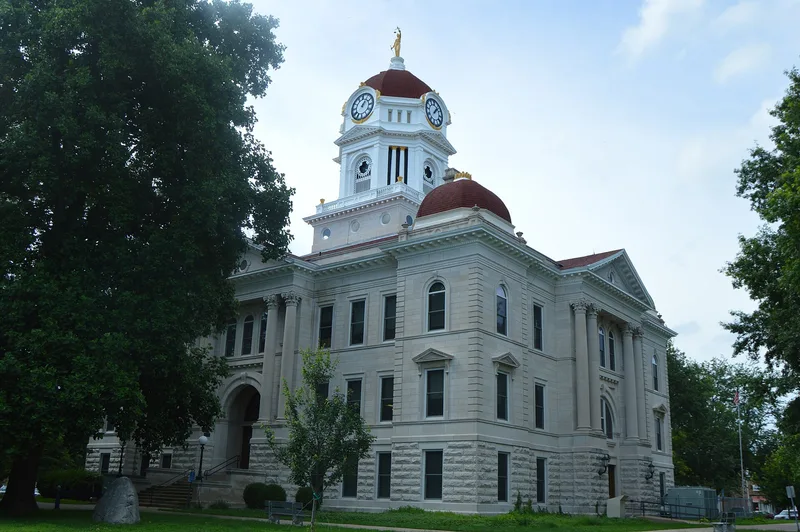
Carthage's courthouse square in Hancock County, Illinois, is a district of brick commercial buildings arranged around the 1908 Beaux Arts courthouse, a three-story building with five domes and a clock tower topped by a figure of justice. The district covers nine quarter-blocks and two corner sites, and every building faces inward toward the courthouse. Its contributing buildings date from 1856, when the Greek Revival Masonic/Odd Fellows Hall was built, to 1923, when the Journal Building went up. Styles include Italianate, Romanesque and plain vernacular commercial, and masonry is used throughout, mostly red clay brick. The father-and-son architects George and Edgar Payne designed or influenced many of the buildings, including oriel windows repeated around the square. Banks, shops, offices and apartments have occupied the buildings over time. Despite altered storefronts, most upper facades survive, giving each block a consistent character. The square has remained the commercial center of the county seat.
Machine-generated summary. This summary was generated by a language model from the official nomination document and has not been reviewed line by line by an editor. It may contain errors. Check the source document before relying on any detail. Source: nomination document (PDF) · catalog entry. Generated October 2026 (model claude-sonnet-5-5, prompt v1.0-2026-10-29).
| Period of significance | 1856-1923 |
|---|---|
| Styles | Greek Revival to Art Deco; mainly Italianate, Romanesque and vernacular commercial |
| Areas of significance | Commerce, Politics/Government, Architecture |
| Acreage | 10 |
| Boundary source | NPS cultural-resource GIS polygon |
| Full listing page | Carthage Courthouse Square Historic District (property record) |
What listing means for this property
This is a historic district. Buildings within its boundary are either contributing (they add to the district's significance) or non-contributing. Owners of contributing income-producing buildings can claim the 20% federal rehabilitation tax credit; homeowners should look at state credits. National Register districts impose no design review by themselves; a local historic district ordinance, if one exists, does (the difference explained).
General information, not legal or tax advice. Rules change; confirm with your State Historic Preservation Office or a qualified adviser.