West Point Commercial Historic District

Why it's listed
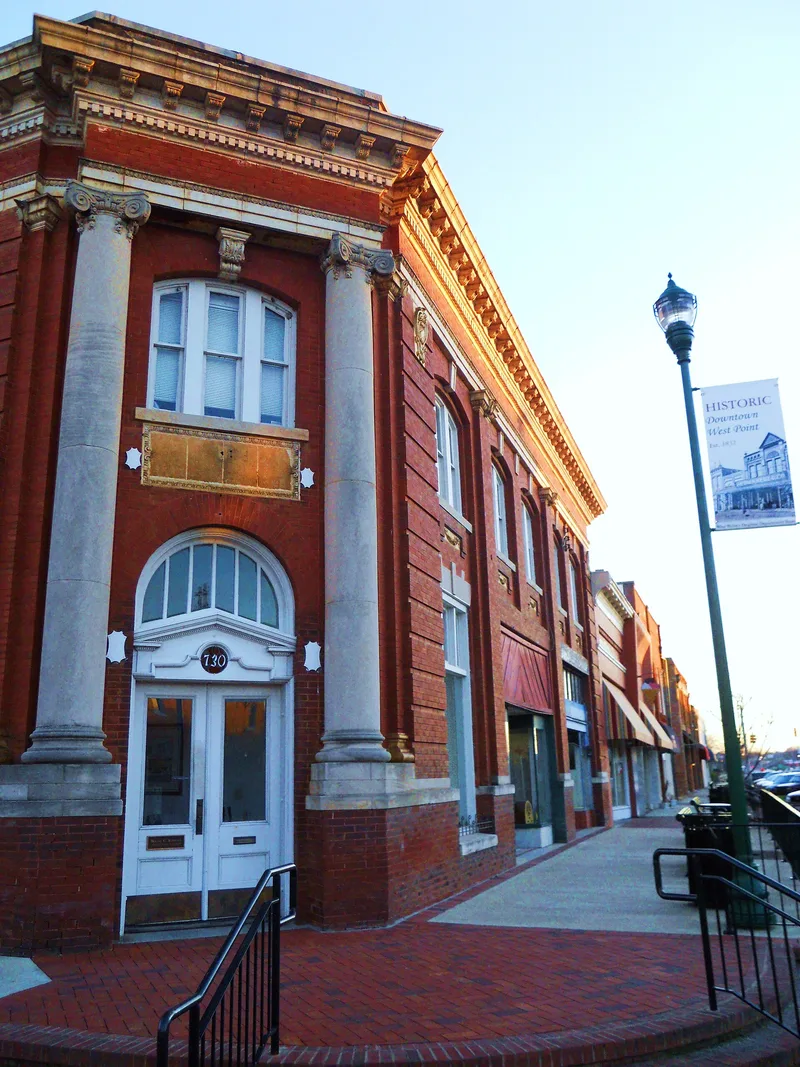
Downtown West Point, on the Chattahoochee River at the Georgia-Alabama line, preserves a compact commercial district of mostly one- and two-story attached brick buildings dating from about 1870 into the mid-20th century. The town grew as a rail hub, where passengers and freight changed trains because of differing track gauges, and later as a trading center for nearby cotton mill villages. Notable buildings include the 1884 Lanier Building, which once held an opera house on its third floor until a 1920 tornado destroyed it, the 1890 Heyman-Merz Building, the 1907 Bank of West Point, and a 1932 Neoclassical Revival post office designed by Louis A. Simon. A 1940 Batson-Cook office was designed by architect Henry J. Toombs. Raised sidewalks recall repeated floods. The district was listed for its role in local commerce and for its representative collection of Commercial-style architecture, with buildings that also record the town's recovery from fires, floods and storms.
Machine-generated summary. This summary was generated by a language model from the official nomination document and has not been reviewed line by line by an editor. It may contain errors. Check the source document before relying on any detail. Source: nomination document (PDF) · catalog entry. Generated October 2026 (model claude-sonnet-5-5, prompt v1.0-2026-10-29).
| Period of significance | c.1870-1955 |
|---|---|
| Styles | Late Victorian; Classical Revival; Commercial Style; Moderne |
| Areas of significance | Architecture, Commerce |
| Acreage | 27 |
| Boundary source | NPS cultural-resource GIS polygon |
| Full listing page | West Point Commercial Historic District (property record) |
What listing means for this property
This is a historic district. Buildings within its boundary are either contributing (they add to the district's significance) or non-contributing. Owners of contributing income-producing buildings can claim the 20% federal rehabilitation tax credit; homeowners should look at state credits. National Register districts impose no design review by themselves; a local historic district ordinance, if one exists, does (the difference explained).
General information, not legal or tax advice. Rules change; confirm with your State Historic Preservation Office or a qualified adviser.