Watson Mill Covered Bridge and Mill Historic District

Why it's listed
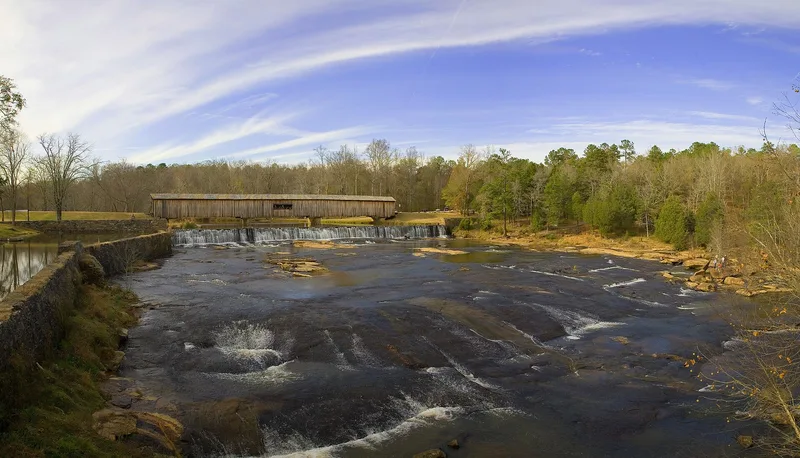
Watson Mill Covered Bridge and Mill Historic District occupies a rural stretch of the South Fork of the Broad River inside Watson Mill State Park, near Comer, Georgia. Its centerpiece is a 229-foot wooden covered bridge built in 1885 by W. W. King with a Town lattice truss. It is the longest of the 16 covered bridges left in Georgia and still carries light traffic. Nearby are the sites of a mill complex run by Gabriel Watson from 1868 to 1904, which included a grist mill, wool carding, sawmill, cotton gin and blacksmith shop. Around 1906-1907 a dam, raceway and power plant were built to supply electricity to a cotton mill in Crawford. The plant closed in 1954 and now survives as ruins. The district was recognized for its engineering, its role in local industry and transportation, and its archaeological potential to reveal how the mill complex worked and how water power gave way to hydroelectricity.
Machine-generated summary. This summary was generated by a language model from the official nomination document and has not been reviewed line by line by an editor. It may contain errors. Check the source document before relying on any detail. Source: nomination document (PDF) · catalog entry. Generated October 2026 (model claude-sonnet-5-5, prompt v1.0-2026-10-29).
| Period of significance | 1868-1907 |
|---|---|
| Styles | No style |
| Areas of significance | Industry, Historic - Non-Aboriginal, Engineering, Transportation |
| Acreage | 23 |
| Boundary source | NPS cultural-resource GIS polygon |
| Full listing page | Watson Mill Covered Bridge and Mill Historic District (property record) |
What listing means for this property
This is a historic district. Buildings within its boundary are either contributing (they add to the district's significance) or non-contributing. Owners of contributing income-producing buildings can claim the 20% federal rehabilitation tax credit; homeowners should look at state credits. National Register districts impose no design review by themselves; a local historic district ordinance, if one exists, does (the difference explained).
General information, not legal or tax advice. Rules change; confirm with your State Historic Preservation Office or a qualified adviser.