Terrell-Sadler House

The National Park Service has not published a boundary polygon for this district; the map shows the listed properties inside it and the district's reference point.
Why it's listed
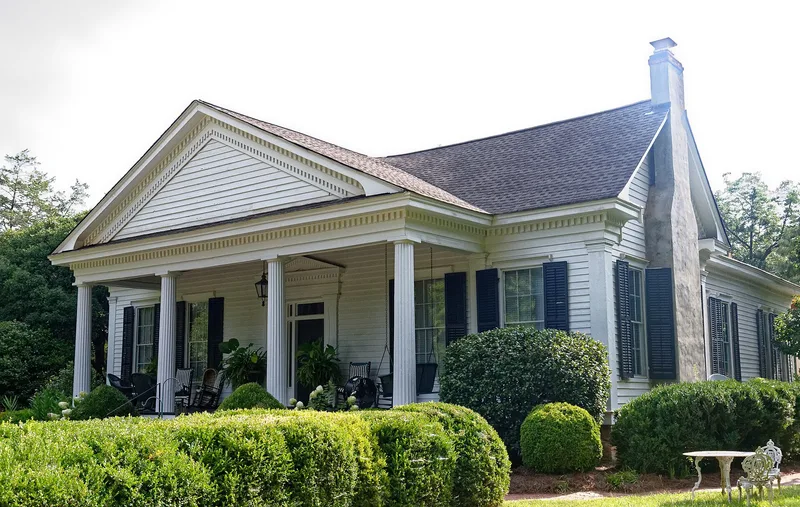
Set on 7.80 acres along Harmony Road in Putnam County, Georgia, this one-story, five-bay Greek Revival house was built around 1855 for William D. Terrell and his wife Mary Sadler Terrell. It was the main house of a plantation that held about 700 acres and 20 enslaved people in 1855. The house has a pedimented portico with Greek Doric columns that swell slightly at the center and rest directly on the porch floor, as in the Greek rather than Roman order. A dentil cornice circles the building, and heavy door, window and fireplace surrounds repeat throughout the six principal rooms. Its triple-pile plan is unusual in Georgia. The property also includes a family cemetery begun in 1865, a 1930s barn and corn crib, and a saddlebag house moved from Eatonton in 1994. The architect or builder is unknown. The house was rehabilitated in the 1990s, and the work received federal certification in 1998.
Machine-generated summary. This summary was generated by a language model from the official nomination document and has not been reviewed line by line by an editor. It may contain errors. Check the source document before relying on any detail. Source: nomination document (PDF) · catalog entry. Generated October 2026 (model claude-sonnet-5-5, prompt v1.0-2026-10-29).
| Period of significance | c.1855 - c.1939 |
|---|---|
| Styles | Mid-19th Century: Greek Revival |
| Areas of significance | Architecture |
| Acreage | 7.8 |
| Boundary source | not published |
| Full listing page | Terrell-Sadler House (property record) |
What listing means for this property
This is a historic district. Buildings within its boundary are either contributing (they add to the district's significance) or non-contributing. Owners of contributing income-producing buildings can claim the 20% federal rehabilitation tax credit; homeowners should look at state credits. National Register districts impose no design review by themselves; a local historic district ordinance, if one exists, does (the difference explained).
General information, not legal or tax advice. Rules change; confirm with your State Historic Preservation Office or a qualified adviser.