Sylvester Commercial Historic District

The National Park Service has not published a boundary polygon for this district; the map shows the listed properties inside it and the district's reference point.
Why it's listed
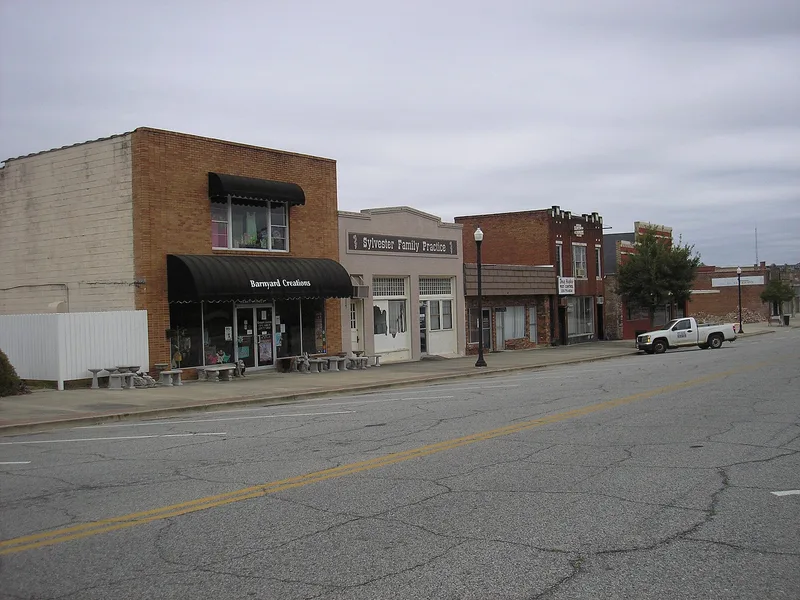
Downtown Sylvester, the seat of Worth County in southwest Georgia, is a compact commercial district of about six acres centered on city block 74 and lined with one- to three-story brick buildings from the 1890s to the 1930s. The town began as Isabella Station, a box car depot on the Brunswick and Albany railroad, and was formally laid out in 1893 on a grid. It became the county seat in 1904. Storefronts along Front, Main, Isabella and Kelly Streets show Beaux Arts, Neoclassical and Victorian Commercial influences, with pressed metal and corbeled brick cornices. Notable buildings include the 1897 Hillhouse hardware store, the three-story Alford Building, the 1910 Sylvester Banking Company, the 1911 newspaper office and the 1915 Sylvia Theater. The district was listed for its architecture, its role as the county's commercial center and its planned railroad town layout. Some facades have been covered or remodeled, but the town plan and most historic buildings remain.
Machine-generated summary. This summary was generated by a language model from the official nomination document and has not been reviewed line by line by an editor. It may contain errors. Check the source document before relying on any detail. Source: nomination document (PDF) · catalog entry. Generated October 2026 (model claude-sonnet-5-5, prompt v1.0-2026-10-29).
| Period of significance | 1881-1930 |
|---|---|
| Styles | Beaux Arts, Neoclassical, and late Victorian Commercial |
| Areas of significance | Community Planning and Development, Commerce, Architecture |
| Acreage | 6 |
| Boundary source | not published |
| Full listing page | Sylvester Commercial Historic District (property record) |
What listing means for this property
This is a historic district. Buildings within its boundary are either contributing (they add to the district's significance) or non-contributing. Owners of contributing income-producing buildings can claim the 20% federal rehabilitation tax credit; homeowners should look at state credits. National Register districts impose no design review by themselves; a local historic district ordinance, if one exists, does (the difference explained).
General information, not legal or tax advice. Rules change; confirm with your State Historic Preservation Office or a qualified adviser.