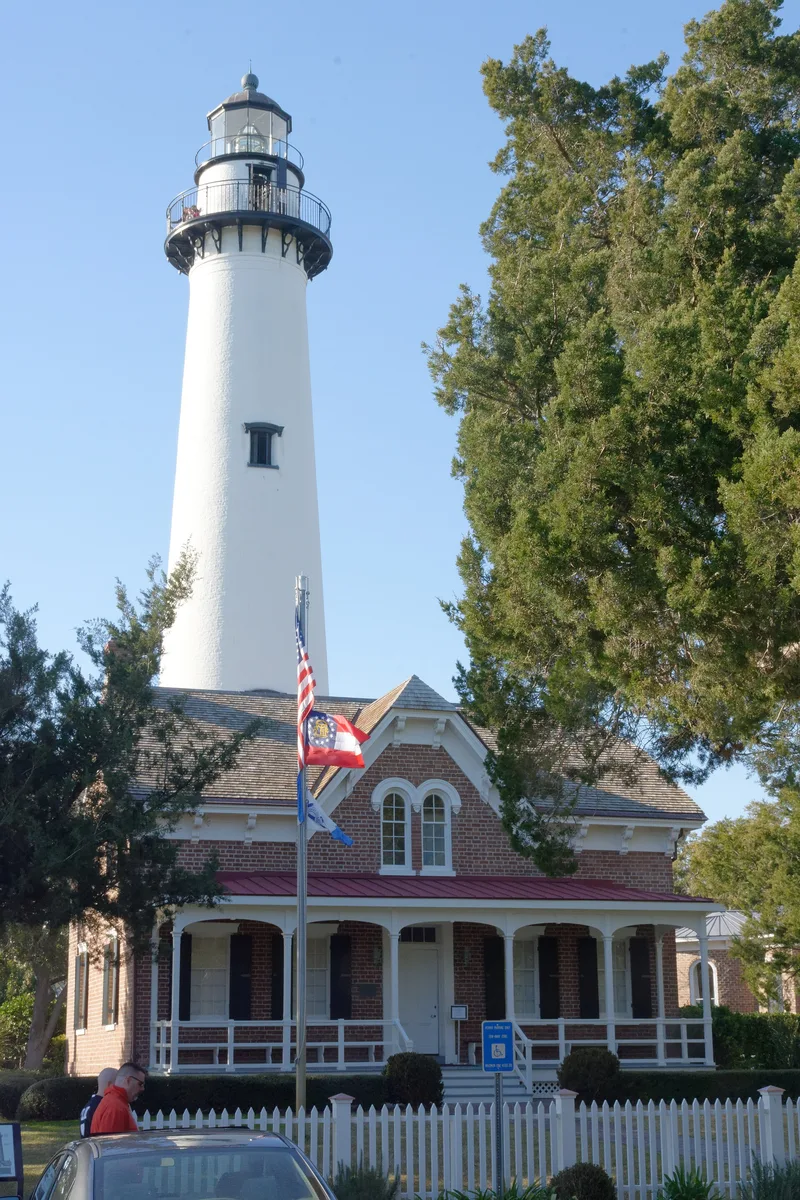
St. Simons Lighthouse and Lighthouse Keepers' Building

The National Park Service has not published a boundary polygon for this district; the map shows the listed properties inside it and the district's reference point.
Why it's listed
On the southern tip of St. Simons Island, Georgia, a two-story brick keepers' building and its neighboring lighthouse guard the entrance to St. Simons Sound and Brunswick harbor. Planned in 1867 and built between 1868 and 1872, the dwelling housed two lighthouse keepers and their families. It combines a Gothic Revival roof with Italianate brackets, drip arches and a one-story porch. The contractor, Charles B. Cluskey, was better known for Classical Revival work such as the Old Governor's Mansion in Milledgeville, and he died during construction. The site was once part of Fort Saint Simons, and an earlier lighthouse from about 1810 was blown up by Confederate soldiers in 1862. Its foundation was later located by archaeologists. The property also includes a small brick oil house from about 1889. Transferred to Glynn County in 1971, the keepers' building now operates as a museum of coastal history, and the lighthouse remains in Coast Guard hands.
Machine-generated summary. This summary was generated by a language model from the official nomination document and has not been reviewed line by line by an editor. It may contain errors. Check the source document before relying on any detail. Source: nomination document (PDF) · catalog entry. Generated October 2026 (model claude-sonnet-5-5, prompt v1.0-2026-10-29).
| Period of significance | 1810-1938 (per 1988 amendment); original 1972 form lists 1868-1872 |
|---|---|
| Styles | Mid-Victorian, Romantic Eclectic (Gothic Revival roof with Italianate details) |
| Areas of significance | Historic - Non-Aboriginal, Transportation, Architecture |
| Acreage | 3.6 |
| Boundary source | not published |
| Full listing page | St. Simons Lighthouse and Lighthouse Keepers' Building (property record) |
What listing means for this property
This is a historic district. Buildings within its boundary are either contributing (they add to the district's significance) or non-contributing. Owners of contributing income-producing buildings can claim the 20% federal rehabilitation tax credit; homeowners should look at state credits. National Register districts impose no design review by themselves; a local historic district ordinance, if one exists, does (the difference explained).
General information, not legal or tax advice. Rules change; confirm with your State Historic Preservation Office or a qualified adviser.