Rankin Square

Why it's listed
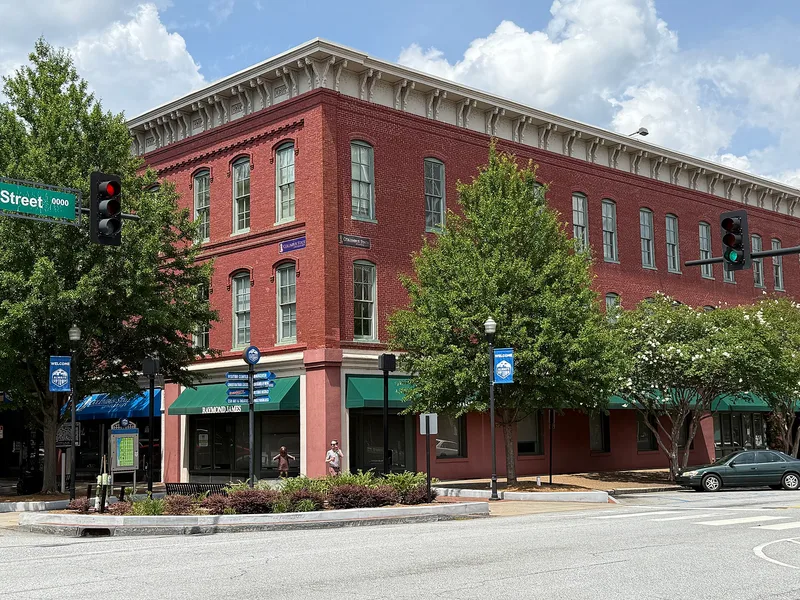
Rankin Square is a full city block of red brick commercial buildings in downtown Columbus, Georgia. The block follows the gridiron plan surveyed by Edward Lloyd Thomas in 1828 and has served as a commercial center ever since. Its focal point is the Rankin Hotel of 1880, a three-story building with a cast-iron marquee, paired wooden brackets and ground-floor shops, with an ell and an 1880s livery stable in a courtyard behind. Other buildings include an antebellum firehouse of about 1855, an 1889 Victorian facade and the 1913 Winer Building. Mostly in High Victorian commercial style, they form a nearly unbroken streetscape of storefronts. The district sits beside the cast-iron Bank of Columbus and the Springer Opera House, and it was listed for its preserved plan, its architectural continuity and its long retail tradition. At the time of nomination, the hotel stood vacant while a private adaptive-use redevelopment restored exteriors and created courtyards and a pedestrian mall.
Machine-generated summary. This summary was generated by a language model from the official nomination document and has not been reviewed line by line by an editor. It may contain errors. Check the source document before relying on any detail. Source: nomination document (PDF) · catalog entry. Generated October 2026 (model claude-sonnet-5-5, prompt v1.0-2026-10-29).
| Period of significance | c. 1828-c. 1913 |
|---|---|
| Styles | High Victorian commercial |
| Areas of significance | Community Planning and Development, Commerce, Architecture |
| Acreage | 4.5 |
| Boundary source | NPS cultural-resource GIS polygon |
| Full listing page | Rankin Square (property record) |
What listing means for this property
This is a historic district. Buildings within its boundary are either contributing (they add to the district's significance) or non-contributing. Owners of contributing income-producing buildings can claim the 20% federal rehabilitation tax credit; homeowners should look at state credits. National Register districts impose no design review by themselves; a local historic district ordinance, if one exists, does (the difference explained).
Noted as vacant in the nomination. Nomination documents can be decades old; current status may differ. If you are considering buying an empty listed property, read the due-diligence checklist.
General information, not legal or tax advice. Rules change; confirm with your State Historic Preservation Office or a qualified adviser.