Old North Campus, University of Georgia

Why it's listed
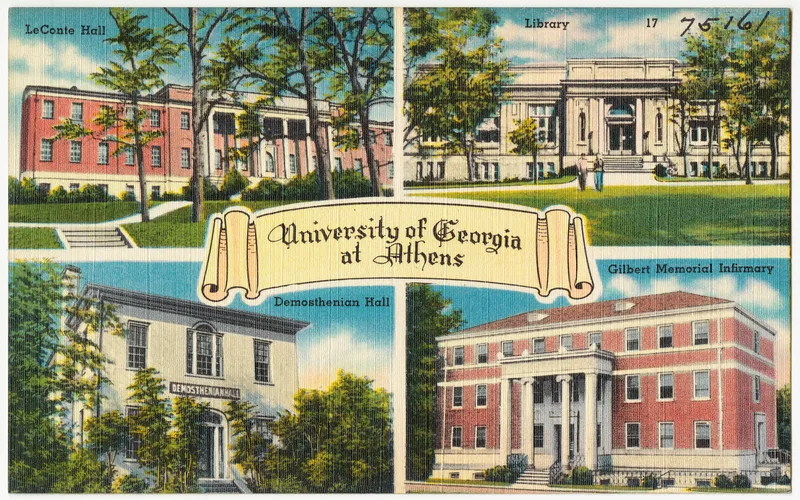
Old North Campus is the historic heart of the University of Georgia in Athens. Entered through an iron arch erected in 1858, the seven-acre district is arranged around two quadrangles and a green near Broad Street, shaded by oaks, magnolias and elms. Old College, built 1801-05, was the first permanent building. Later structures include Waddel Hall, New College, Demosthenian Hall, the Chapel, Phi Kappa Hall, Lustrat House, Moore College and the Academic Building of 1903, spanning Federal, Greek Revival, Second Empire and Neo-Classical styles. The university, chartered in 1785 as the first state-chartered university in America, gave rise to the town of Athens, which was incorporated in 1806. Figures such as Alexander Stephens, Crawford W. Long, Robert Toombs and Henry W. Grady are linked to its halls and literary societies. The area remained the center of the university well into the twentieth century and is still regarded as its heart.
Machine-generated summary. This summary was generated by a language model from the official nomination document and has not been reviewed line by line by an editor. It may contain errors. Check the source document before relying on any detail. Source: nomination document (PDF) · catalog entry. Generated October 2026 (model claude-sonnet-5-5, prompt v1.0-2026-10-29).
| Period of significance | c. 1801 - 1903 |
|---|---|
| Styles | Federal, Greek Revival, Second Empire and Neo-Classical |
| Areas of significance | Landscape Architecture, Education, Architecture |
| Acreage | 7 |
| Boundary source | NPS cultural-resource GIS polygon |
| Full listing page | Old North Campus, University of Georgia (property record) |
What listing means for this property
This is a historic district. Buildings within its boundary are either contributing (they add to the district's significance) or non-contributing. Owners of contributing income-producing buildings can claim the 20% federal rehabilitation tax credit; homeowners should look at state credits. National Register districts impose no design review by themselves; a local historic district ordinance, if one exists, does (the difference explained).
General information, not legal or tax advice. Rules change; confirm with your State Historic Preservation Office or a qualified adviser.