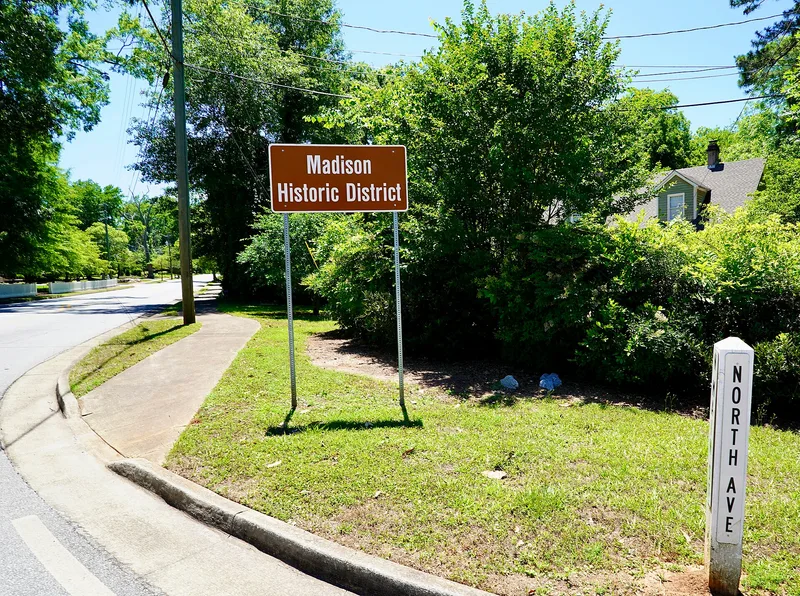
Madison Historic District

Why it's listed
Madison, Georgia, has a district of roughly 250 acres that holds the core of its nineteenth-century residential neighborhoods. Tree-lined streets such as Main, Old Post Road, Academy, Jefferson and Washington hold houses ranging from a frame servant's quarters to Greek Revival cottages, columned mansions and sprawling Victorian homes. Notable examples include Boxwood (1851), the Stokes McHenry House, Bonar Hall, the Nathan Hunter House and several churches, among them an 1840 red brick Episcopal church. The district reflects the wealth that cotton planters and merchants built after settling in the area, along with their investment in schools, including a women's college founded in 1849, and the arrival of the Georgia Railroad. A Federal soldier described the town as the prettiest village he had seen in the state, and Madison was spared from Sherman's destruction after a plea from Senator Joshua Hill. A later addition recognized the Bearden Chambers House, a Victorian cottage of about 1850.
Machine-generated summary. This summary was generated by a language model from the official nomination document and has not been reviewed line by line by an editor. It may contain errors. Check the source document before relying on any detail. Source: nomination document (PDF) · catalog entry. Generated October 2026 (model claude-sonnet-5-5, prompt v1.0-2026-10-29).
| Period of significance | 19th Century |
|---|---|
| Styles | Greek Revival, plantation plain, early Victorian and later Victorian |
| Areas of significance | Architecture, Social History |
| Acreage | 250 |
| Boundary source | NPS cultural-resource GIS polygon |
| Full listing page | Madison Historic District (property record) |
What listing means for this property
This is a historic district. Buildings within its boundary are either contributing (they add to the district's significance) or non-contributing. Owners of contributing income-producing buildings can claim the 20% federal rehabilitation tax credit; homeowners should look at state credits. National Register districts impose no design review by themselves; a local historic district ordinance, if one exists, does (the difference explained).
General information, not legal or tax advice. Rules change; confirm with your State Historic Preservation Office or a qualified adviser.