Louvale Church Row Historic District

The National Park Service has not published a boundary polygon for this district; the map shows the listed properties inside it and the district's reference point.
Why it's listed
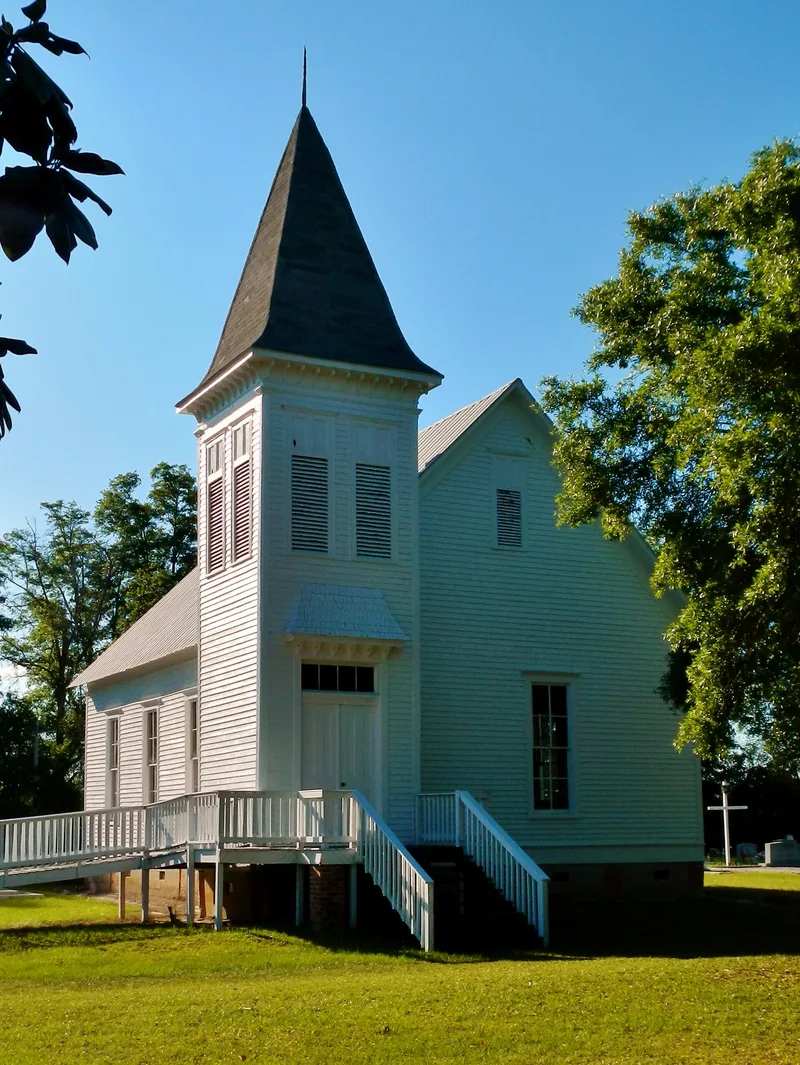
Louvale Church Row is a small group of rural buildings on the west side of U.S. 27 in Stewart County, Georgia. Three frame churches, a two-room frame school and a small cemetery sit in a line on four adjoining one-acre lots shaded by live oaks. The churches are Antioch Primitive Baptist, Louvale United Methodist and New Hope Baptist. Each has a one-room sanctuary, but their belfries and interior trim differ. Antioch dates from the Baptist congregation that moved here in 1851 and operated a school, later called Antioch Institute, which Stewart County bought in 1895 for use as a public school. The Methodist and New Hope congregations bought neighboring lots in 1899 and 1900. After the planned railroad town failed to develop, the churches and school held the community together. Antioch declined in the 1950s and was restored by 1984, with Sacred Harp singing schools revived. The district is valued for its architecture, religion, education and community planning.
Machine-generated summary. This summary was generated by a language model from the official nomination document and has not been reviewed line by line by an editor. It may contain errors. Check the source document before relying on any detail. Source: nomination document (PDF) · catalog entry. Generated October 2026 (model claude-sonnet-5-5, prompt v1.0-2026-10-29).
| Period of significance | 1851 - 1902 |
|---|---|
| Styles | Small, wood-framed, 19th-century rural Protestant churches with Gothic-influenced detailing and a frame rural schoolhouse |
| Areas of significance | Education, Architecture, Religion |
| Acreage | 4 |
| Boundary source | not published |
| Full listing page | Louvale Church Row Historic District (property record) |
What listing means for this property
This is a historic district. Buildings within its boundary are either contributing (they add to the district's significance) or non-contributing. Owners of contributing income-producing buildings can claim the 20% federal rehabilitation tax credit; homeowners should look at state credits. National Register districts impose no design review by themselves; a local historic district ordinance, if one exists, does (the difference explained).
General information, not legal or tax advice. Rules change; confirm with your State Historic Preservation Office or a qualified adviser.