Lake Acworth Beach and Bathhouse

The National Park Service has not published a boundary polygon for this district; the map shows the listed properties inside it and the district's reference point.
Why it's listed
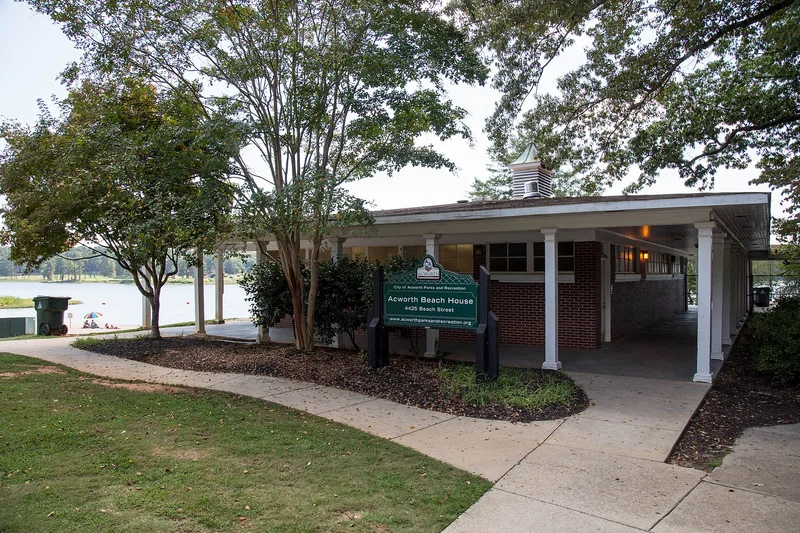
Lake Acworth Beach and Bathhouse is a public recreation complex on the north shore of Lake Acworth, about 25 miles northwest of Atlanta. The one-story brick bathhouse, designed by Bothwell & Nash of Marietta, was completed in 1953 and dedicated by Governor Herman Talmadge before a crowd of 600. Its low hip roof, cupola and wraparound porch colonnade combine mid-century modern form with Colonial Revival details. The crescent beach was built from 20 rail-car loads of sand to soften the red-clay shoreline. The complex was promoted as a summer escape from Atlanta and became a favored gathering place for local groups. It was built for whites only during legal segregation, and African Americans in the area had to travel to George Washington Carver State Park on Allatoona Lake. The district includes the bathhouse and beach as contributing resources, while a 1962 social hall, three pavilions and a dock were added later and do not contribute. Its period of significance runs from 1953 to 1955.
Machine-generated summary. This summary was generated by a language model from the official nomination document and has not been reviewed line by line by an editor. It may contain errors. Check the source document before relying on any detail. Source: nomination document (PDF) · catalog entry. Generated October 2026 (model claude-sonnet-5-5, prompt v1.0-2026-10-29).
| Period of significance | 1953-1955 |
|---|---|
| Styles | Modern Movement, with Colonial Revival elements |
| Areas of significance | Architecture, Entertainment/Recreation, Social History |
| Acreage | 5 |
| Boundary source | not published |
| Full listing page | Lake Acworth Beach and Bathhouse (property record) |
What listing means for this property
This is a historic district. Buildings within its boundary are either contributing (they add to the district's significance) or non-contributing. Owners of contributing income-producing buildings can claim the 20% federal rehabilitation tax credit; homeowners should look at state credits. National Register districts impose no design review by themselves; a local historic district ordinance, if one exists, does (the difference explained).
General information, not legal or tax advice. Rules change; confirm with your State Historic Preservation Office or a qualified adviser.