King Plow Company

The National Park Service has not published a boundary polygon for this district; the map shows the listed properties inside it and the district's reference point.
Why it's listed
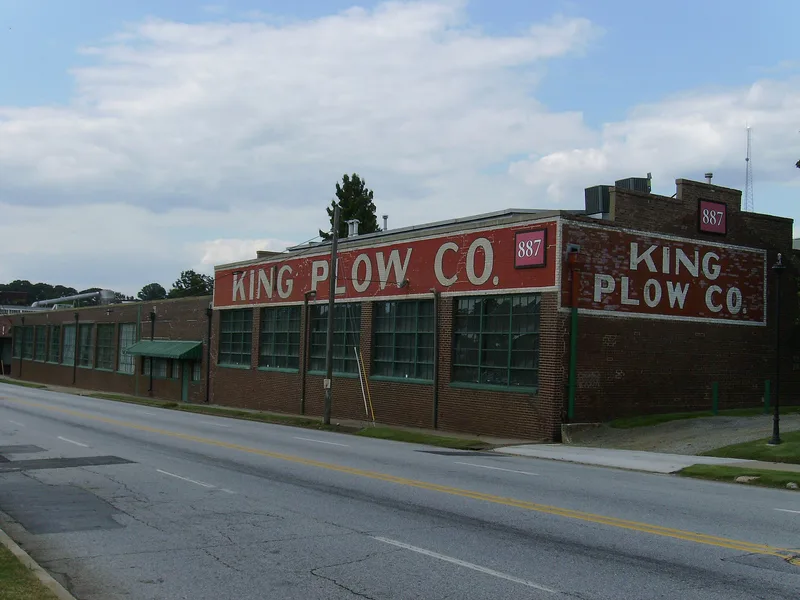
This 7.8-acre complex on West Marietta Street in Atlanta was the main manufacturing plant of the King Plow Company, which made farming implements from 1901 to 1986 and shipped to over 38 states and other countries. Ten contributing brick and steel buildings sit beside the railroad tracks. The earliest, built about 1902, use load-bearing masonry walls, heavy timber post-and-beam supports, and segmentally arched windows. Those added in 1936 use steel post-and-truss framing with large factory sash windows. Together they show the move from wood and masonry to steel construction. A c.1940 brick cottage served as the main office. A 1968 steel storage building is noncontributing. The complex was listed for its role in Georgia's industrial history and as an intact example of utilitarian factory design. It has been rehabilitated as an arts center with loft housing, galleries, studios, and performance space, and it is one of the few surviving examples of this type of rail-side industrial complex in Atlanta.
Machine-generated summary. This summary was generated by a language model from the official nomination document and has not been reviewed line by line by an editor. It may contain errors. Check the source document before relying on any detail. Source: nomination document (PDF) · catalog entry. Generated October 2026 (model claude-sonnet-5-5, prompt v1.0-2026-10-29).
| Period of significance | 1902-1946 |
|---|---|
| Styles | OTHER: functional |
| Areas of significance | Architecture, Industry |
| Acreage | 7.8 |
| Boundary source | not published |
| Full listing page | King Plow Company (property record) |
What listing means for this property
This is a historic district. Buildings within its boundary are either contributing (they add to the district's significance) or non-contributing. Owners of contributing income-producing buildings can claim the 20% federal rehabilitation tax credit; homeowners should look at state credits. National Register districts impose no design review by themselves; a local historic district ordinance, if one exists, does (the difference explained).
General information, not legal or tax advice. Rules change; confirm with your State Historic Preservation Office or a qualified adviser.