Kennesaw Mountain National Battlefield Park

Why it's listed
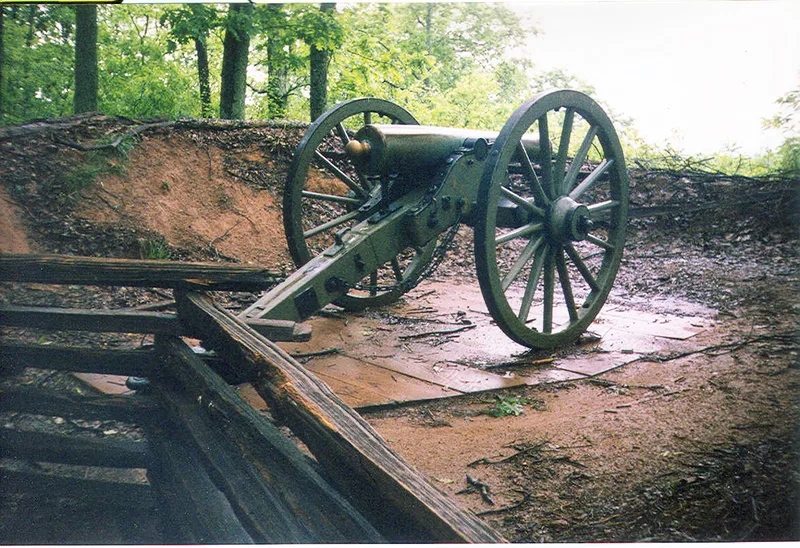
Kennesaw Mountain National Battlefield Park occupies a crescent-shaped ridge on the western edge of Marietta, Georgia, where Union and Confederate armies clashed in June 1864 during the Atlanta Campaign. Confederate forces held a ten-mile line here from June 18, and Sherman's major assault on June 27 failed, though his flanking moves forced the Confederates to abandon the line on July 2. Casualties numbered about 5,500. With the loss of Kennesaw, the last major geographic barrier shielding Atlanta was gone, and the city fell on September 1. The park preserves roughly 11 miles of earthworks, including rifle pits, trenches and gun emplacements, with the best examples near Strahl's Fort. It also protects the Kolb House, a hewn-log dwelling built in 1836 that served as General Hooker's headquarters, and monuments such as the Illinois Monument of 1914 at Cheatham Hill. Congress established the park in 1935.
Machine-generated summary. This summary was generated by a language model from the official nomination document and has not been reviewed line by line by an editor. It may contain errors. Check the source document before relying on any detail. Source: nomination document (PDF) · catalog entry. Generated October 2026 (model claude-sonnet-5-5, prompt v1.0-2026-10-29).
| Styles | Civil War earthworks; Early Republic: Federal; Modern Movement: Modernistic |
|---|---|
| Areas of significance | Engineering, Military, Architecture |
| Acreage | 2882 |
| Boundary source | NPS cultural-resource GIS polygon |
| Full listing page | Kennesaw Mountain National Battlefield Park (property record) |
What listing means for this property
This is a historic district. Buildings within its boundary are either contributing (they add to the district's significance) or non-contributing. Owners of contributing income-producing buildings can claim the 20% federal rehabilitation tax credit; homeowners should look at state credits. National Register districts impose no design review by themselves; a local historic district ordinance, if one exists, does (the difference explained).
General information, not legal or tax advice. Rules change; confirm with your State Historic Preservation Office or a qualified adviser.