Home Park School

The National Park Service has not published a boundary polygon for this district; the map shows the listed properties inside it and the district's reference point.
Why it's listed
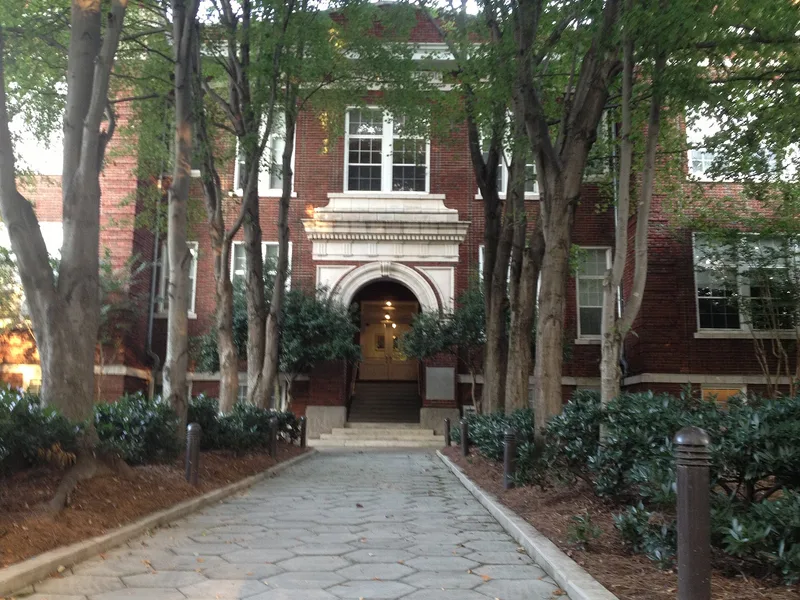
Home Park School, at 1031 State Street NW in Atlanta, opened in September 1911 as an elementary school for the Home Park neighborhood. Atlanta architect Edward Dougherty designed the two-story brick building with a basement in the Italian Renaissance Revival style, using terra cotta trim, a rusticated stone foundation, brick quoins and a prominent arched entrance. Auditorium (1929) and classroom and cafeteria (1937) additions are plainer, reflecting Depression-era economy and Moderne influence. The school replaced the older Ethel Street School after Atlanta absorbed it into the city system, and Dougherty designed five other Atlanta schools in the same period. A 1921 survey rated it second among the city's elementary schools. It served pupils until 1986 and has since been converted to apartments, keeping its wide corridors, wood moldings, hardwood floors and stairways. A newer apartment building on the grounds does not contribute to the property's historic character.
Machine-generated summary. This summary was generated by a language model from the official nomination document and has not been reviewed line by line by an editor. It may contain errors. Check the source document before relying on any detail. Source: nomination document (PDF) · catalog entry. Generated October 2026 (model claude-sonnet-5-5, prompt v1.0-2026-10-29).
| Period of significance | 1911-1937 |
|---|---|
| Styles | Late 19th/20th Century Revival/Italian Renaissance |
| Areas of significance | Education, Architecture |
| Acreage | 1.5 |
| Boundary source | not published |
| Full listing page | Home Park School (property record) |
What listing means for this property
This is a historic district. Buildings within its boundary are either contributing (they add to the district's significance) or non-contributing. Owners of contributing income-producing buildings can claim the 20% federal rehabilitation tax credit; homeowners should look at state credits. National Register districts impose no design review by themselves; a local historic district ordinance, if one exists, does (the difference explained).
General information, not legal or tax advice. Rules change; confirm with your State Historic Preservation Office or a qualified adviser.