Highland School

The National Park Service has not published a boundary polygon for this district; the map shows the listed properties inside it and the district's reference point.
Why it's listed
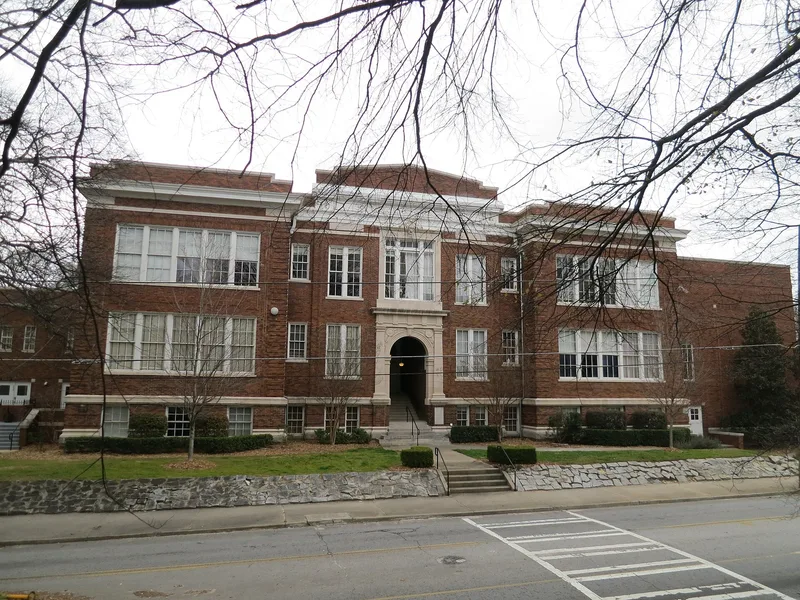
Highland School is a two-story red brick former elementary school at 978 North Avenue NE in Atlanta's Poncey-Highland neighborhood. Atlanta's public school system bought the land in 1910, and the cornerstone was laid in June 1911. Architect Edward E. Dougherty, an Atlanta native trained at the Ecole des Beaux Arts in Paris, designed the Classical Revival building with terra cotta cornices, brick quoins, a stepped parapet and raised lettering reading Highland School. An auditorium was added in 1929, and a four-classroom wing followed in 1937 with Works Progress Administration help. The school served kindergarten through sixth grade, initially for white children only, until it closed in 1972. The school system then used it as offices until the late 1990s. It has since been converted into 30 condominiums. The exterior still looks much as it did in 1937, with original wood windows intact. It was listed for its architecture and for its role in local public education.
Machine-generated summary. This summary was generated by a language model from the official nomination document and has not been reviewed line by line by an editor. It may contain errors. Check the source document before relying on any detail. Source: nomination document (PDF) · catalog entry. Generated October 2026 (model claude-sonnet-5-5, prompt v1.0-2026-10-29).
| Period of significance | 1911-1956 |
|---|---|
| Styles | Late 19th and 20th Century Revivals: Classical Revival |
| Areas of significance | Architecture, Education |
| Acreage | 2.5 |
| Boundary source | not published |
| Full listing page | Highland School (property record) |
What listing means for this property
This is a historic district. Buildings within its boundary are either contributing (they add to the district's significance) or non-contributing. Owners of contributing income-producing buildings can claim the 20% federal rehabilitation tax credit; homeowners should look at state credits. National Register districts impose no design review by themselves; a local historic district ordinance, if one exists, does (the difference explained).
General information, not legal or tax advice. Rules change; confirm with your State Historic Preservation Office or a qualified adviser.