Head's Mill

The National Park Service has not published a boundary polygon for this district; the map shows the listed properties inside it and the district's reference point.
Why it's listed
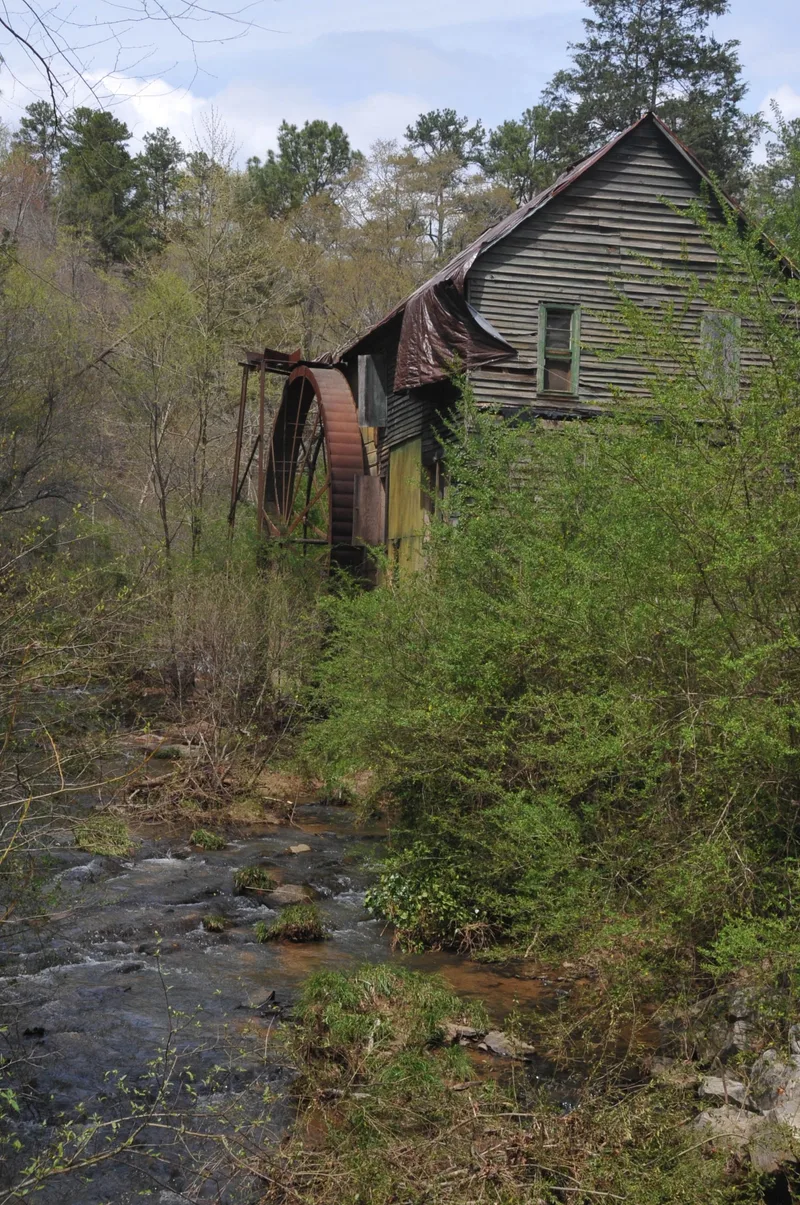
Head's Mill is a former water-powered grist mill complex beside the North Oconee River near Lula, Hall County, Georgia. The two-and-one-half-story, mortise-and-tenon frame mill dates from about 1850 and was run by William Head, who bought the site in 1852. The complex also includes a dam of early poured concrete probably from the 1880s, a sluiceway, an elevated millrace, a brick garage and a barn from about 1890 that once held a wine press. A metal overshot wheel and millrace replaced wooden ones in the 1930s. The mill ground corn, feed and some grain for local farms, and at various times housed a cotton gin, shingle mill, sawmill and feed crusher. Surplus meal was sold in Gainesville. It operated until the 1950s and is described as the only surviving grist mill in Hall County. Its wheel and raised millrace design is described as unusual for north Georgia. The property is currently not in use.
Machine-generated summary. This summary was generated by a language model from the official nomination document and has not been reviewed line by line by an editor. It may contain errors. Check the source document before relying on any detail. Source: nomination document (PDF) · catalog entry. Generated October 2026 (model claude-sonnet-5-5, prompt v1.0-2026-10-29).
| Period of significance | C. 1850-1939 |
|---|---|
| Styles | Other: functional |
| Areas of significance | Industry, Engineering, Architecture |
| Acreage | 3 |
| Boundary source | not published |
| Full listing page | Head's Mill (property record) |
What listing means for this property
This is a historic district. Buildings within its boundary are either contributing (they add to the district's significance) or non-contributing. Owners of contributing income-producing buildings can claim the 20% federal rehabilitation tax credit; homeowners should look at state credits. National Register districts impose no design review by themselves; a local historic district ordinance, if one exists, does (the difference explained).
Noted as vacant in the nomination. Nomination documents can be decades old; current status may differ. If you are considering buying an empty listed property, read the due-diligence checklist.
General information, not legal or tax advice. Rules change; confirm with your State Historic Preservation Office or a qualified adviser.