Georgia Marble Company and Tate Historic District

Why it's listed
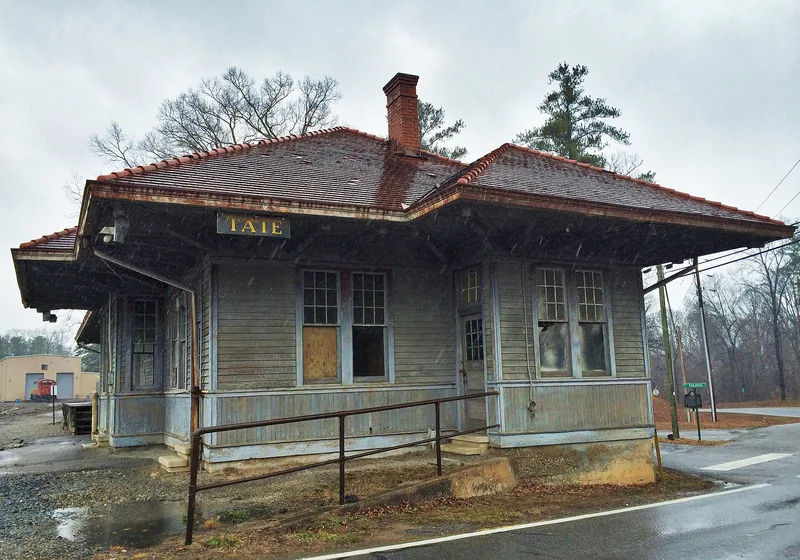
Tate, in the mountains of Pickens County, Georgia, is a company town built around the Georgia Marble Company. Streets wind along ridges and valleys beside Georgia Highway 53, with houses on high ground and the quarries in the Long Swamp Creek valley to the east. A railroad spur threads through town to the quarries and finishing sheds. Most homes are modest one-story pyramidal cottages, shotgun and saddlebag houses, and Craftsman bungalows built from about 1900 to 1930. Col. Sam Tate, company president from 1905, laid out much of the community and had company carpenters build the housing. Marble appears throughout the town: Tate High School of 1928 is faced in marble, the Tate Gymnasium of 1923 rests on a marble foundation, and the Tate House of 1923 is built of Etowah pink marble. Two Gothic Revival Methodist churches date from 1887, and Smoky Hollow preserves part of the African-American community. Together these resources show how marble quarrying shaped the town's work, housing and civic life.
Machine-generated summary. This summary was generated by a language model from the official nomination document and has not been reviewed line by line by an editor. It may contain errors. Check the source document before relying on any detail. Source: nomination document (PDF) · catalog entry. Generated October 2026 (model claude-sonnet-5-5, prompt v1.0-2026-10-29).
| Styles | Late 19th and 20th Century Revivals (Late Gothic Revival, Colonial Revival, Classical Revival); Bungalow/Craftsman; pyramidal cottage, central-hall house, saddlebag, shotgun house |
|---|---|
| Areas of significance | Art, Architecture, Engineering, Community Planning and Development, Industry |
| Acreage | 550 |
| Boundary source | NPS cultural-resource GIS polygon |
| Full listing page | Georgia Marble Company and Tate Historic District (property record) |
What listing means for this property
This is a historic district. Buildings within its boundary are either contributing (they add to the district's significance) or non-contributing. Owners of contributing income-producing buildings can claim the 20% federal rehabilitation tax credit; homeowners should look at state credits. National Register districts impose no design review by themselves; a local historic district ordinance, if one exists, does (the difference explained).
General information, not legal or tax advice. Rules change; confirm with your State Historic Preservation Office or a qualified adviser.