Fox Theatre Historic District

The National Park Service has not published a boundary polygon for this district; the map shows the listed properties inside it and the district's reference point.
Why it's listed
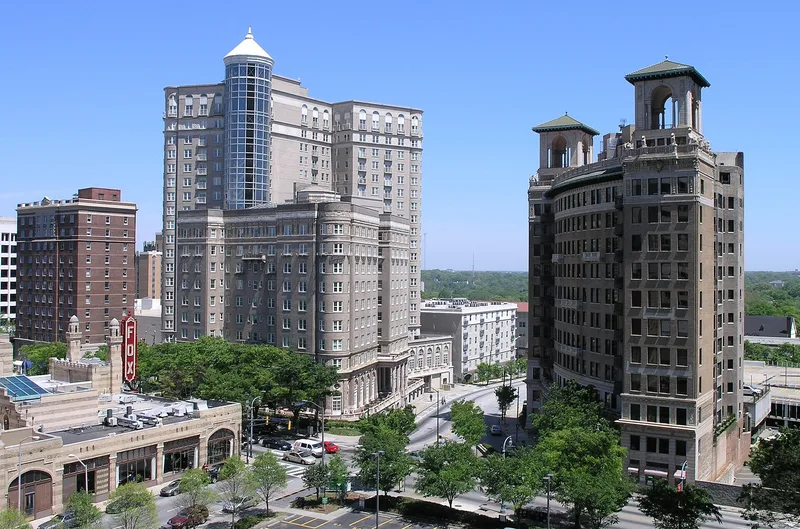
At the crossing of Peachtree Street and Ponce de Leon Avenue in Atlanta, three early twentieth-century landmarks occupy three corners: the Fox Theatre, the Georgian Terrace Hotel and the Ponce de Leon Apartments. The hotel, a ten-story brick and marble building designed by W. L. Stoddard and opened in 1911, was modeled as a southern version of a Parisian hotel and was long the city's most luxurious. Stoddard also designed the curving, Italianate apartment building completed in 1913, one of Atlanta's first large high-rise luxury apartment houses. Across the street, the Fox Theatre, with onion domes and a large marquee, provides a bold contrast in style. The district was recognized less for the three buildings individually than for how they work together, shaping the space and movement of one of the city's busiest intersections. Its listing also came as the once-darkened theatre was being revived, bringing renewed attention to the area.
Machine-generated summary. This summary was generated by a language model from the official nomination document and has not been reviewed line by line by an editor. It may contain errors. Check the source document before relying on any detail. Source: nomination document (PDF) · catalog entry. Generated October 2026 (model claude-sonnet-5-5, prompt v1.0-2026-10-29).
| Styles | Beaux-Arts (Georgian Terrace Hotel); Italianate with Italian Mannerism influence (Ponce de Leon Apartments); Arabic-inspired motion picture palace (Fox Theatre) |
|---|---|
| Areas of significance | Commerce, Architecture |
| Acreage | 3 |
| Boundary source | not published |
| Full listing page | Fox Theatre Historic District (property record) |
What listing means for this property
This is a historic district. Buildings within its boundary are either contributing (they add to the district's significance) or non-contributing. Owners of contributing income-producing buildings can claim the 20% federal rehabilitation tax credit; homeowners should look at state credits. National Register districts impose no design review by themselves; a local historic district ordinance, if one exists, does (the difference explained).
General information, not legal or tax advice. Rules change; confirm with your State Historic Preservation Office or a qualified adviser.