Fort Screven Historic District

The National Park Service has not published a boundary polygon for this district; the map shows the listed properties inside it and the district's reference point.
Why it's listed
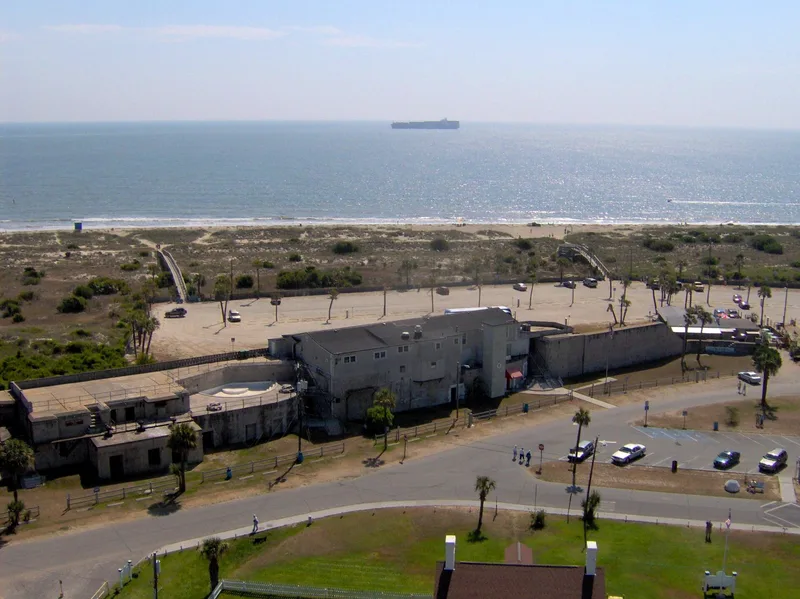
Fort Screven and Tybee Light occupy the northern head of Tybee Island, fifteen miles east of Savannah, where they guarded the shipping channel into the port. Planned in 1897, the fort includes six concrete gun batteries, a crescent-shaped Officers Row on a sixteen-foot earthen berm, a fort village with barracks and support buildings, and a quartermaster area. The original guns were removed for scrap during World War II. Some batteries now serve as foundations for homes, and Battery Garland holds the Tybee Museum. The wood-frame officers' houses, built of cypress and pine, have double galleried porches, slate roofs and pressed-tin ceilings. The lighthouse, with a first-order Fresnel lens dating to an 1867 rebuilding, has brick walls twelve feet thick at the base and a 140-foot cast-iron stair. Its two larger cottages are described as the only known Stick-style buildings from the 1870s or 1880s remaining on the island.
Machine-generated summary. This summary was generated by a language model from the official nomination document and has not been reviewed line by line by an editor. It may contain errors. Check the source document before relying on any detail. Source: nomination document (PDF) · catalog entry. Generated October 2026 (model claude-sonnet-5-5, prompt v1.0-2026-10-29).
| Styles | Vernacular Colonial Queen Anne (Officers Row); Stick style (lighthouse cottages); Beaux Arts Classical interior detail |
|---|---|
| Areas of significance | Community Planning and Development, Landscape Architecture, Military, Engineering, Transportation, Exploration/Settlement, Architecture, Communications |
| Acreage | 205 |
| Boundary source | not published |
| Full listing page | Fort Screven Historic District (property record) |
What listing means for this property
This is a historic district. Buildings within its boundary are either contributing (they add to the district's significance) or non-contributing. Owners of contributing income-producing buildings can claim the 20% federal rehabilitation tax credit; homeowners should look at state credits. National Register districts impose no design review by themselves; a local historic district ordinance, if one exists, does (the difference explained).
General information, not legal or tax advice. Rules change; confirm with your State Historic Preservation Office or a qualified adviser.