Fort Oglethorpe Historic District

Why it's listed
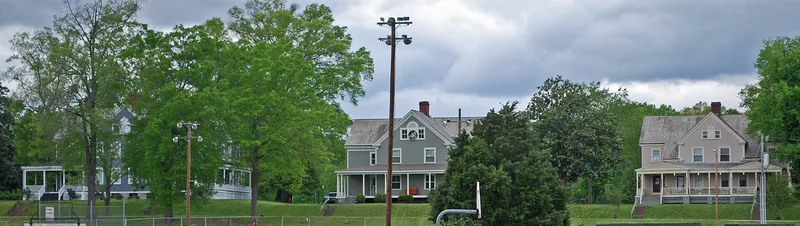
Fort Oglethorpe began as an army cavalry post founded between 1902 and 1904 and closed after World War II. Its surviving core is a district of roughly three dozen buildings and several landscaped areas laid out on a carefully ordered plan. The centerpiece is Barnhardt Circle, a tree-bordered oval that served as the parade ground and polo field. Officers' houses and duplexes line its south side, built as two-and-a-half-story clapboard structures with Queen Anne massing, wrap-around porches, Palladian windows and Tuscan columns. House types varied by rank, from the commanding officer's residence to captains' and lieutenants' duplexes and a three-story bachelor officers' quarters. The enlisted barracks on the north side are gone. Beyond the circle stand service buildings, including stables, a blacksmith shop, a powder magazine, water tanks, a commissary and quartermaster's headquarters, a chapel, theater, gymnasium, hospital, post exchange, officers' club and bandstand. Many remain in use, either as homes or in new roles, and the landscape keeps much of its original appearance.
Machine-generated summary. This summary was generated by a language model from the official nomination document and has not been reviewed line by line by an editor. It may contain errors. Check the source document before relying on any detail. Source: nomination document (PDF) · catalog entry. Generated October 2026 (model claude-sonnet-5-5, prompt v1.0-2026-10-29).
| Styles | Domestic style with irregular Queen Anne massing and neoclassical detailing (Palladian windows, Tuscan columns) |
|---|---|
| Areas of significance | Community Planning and Development, Landscape Architecture, Military, Architecture, Religion |
| Acreage | 178 |
| Boundary source | NPS cultural-resource GIS polygon |
| Full listing page | Fort Oglethorpe Historic District (property record) |
What listing means for this property
This is a historic district. Buildings within its boundary are either contributing (they add to the district's significance) or non-contributing. Owners of contributing income-producing buildings can claim the 20% federal rehabilitation tax credit; homeowners should look at state credits. National Register districts impose no design review by themselves; a local historic district ordinance, if one exists, does (the difference explained).
General information, not legal or tax advice. Rules change; confirm with your State Historic Preservation Office or a qualified adviser.