Fort Frederica National Monument (Additional Documentation)

The National Park Service has not published a boundary polygon for this district; the map shows the listed properties inside it and the district's reference point.
Why it's listed
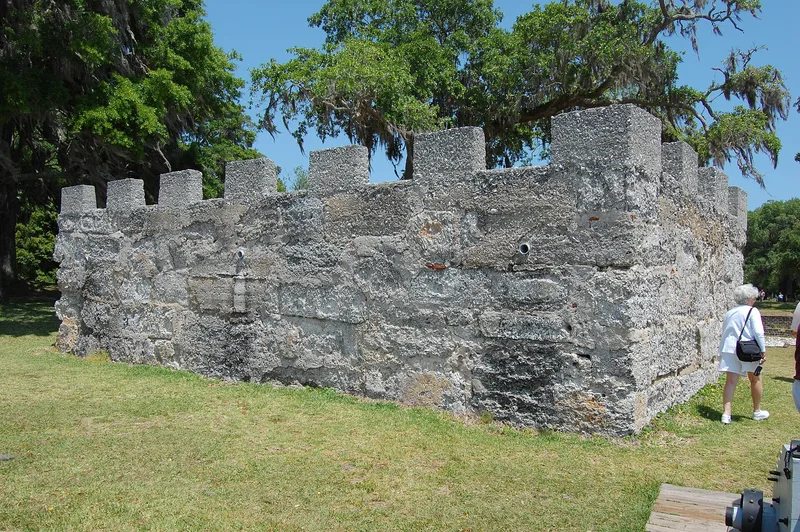
Fort Frederica National Monument preserves the remains of a fortified British colonial town founded in 1736 on St. Simons Island, Georgia. Most surviving features are tabby or brick foundations of houses, storehouses, a barracks, the King's Magazine, a burial ground, and earthen works including the town moat. The district also includes the Bloody Marsh Battle Site, a wooded and marshy eight-acre tract where British defenders stopped a Spanish advance in July 1742. Frederica served as the headquarters of Oglethorpe's regiment and the center of the colony's defense against Spain during the War of Jenkins' Ear. At its peak the town held about 1,500 people, including skilled tradesmen, and John and Charles Wesley preached there. The town declined after the regiment disbanded in 1749, a fire in 1758 destroyed most buildings, and the last soldiers left in 1763. The National Park Service now maintains the site.
Machine-generated summary. This summary was generated by a language model from the official nomination document and has not been reviewed line by line by an editor. It may contain errors. Check the source document before relying on any detail. Source: nomination document (PDF) · catalog entry. Generated October 2026 (model claude-sonnet-5-5, prompt v1.0-2026-10-29).
| Period of significance | 18th Century |
|---|---|
| Areas of significance | Military, Social History |
| Acreage | 218 |
| Boundary source | not published |
| Full listing page | Fort Frederica National Monument (Additional Documentation) (property record) |
What listing means for this property
This is a historic district. Buildings within its boundary are either contributing (they add to the district's significance) or non-contributing. Owners of contributing income-producing buildings can claim the 20% federal rehabilitation tax credit; homeowners should look at state credits. National Register districts impose no design review by themselves; a local historic district ordinance, if one exists, does (the difference explained).
General information, not legal or tax advice. Rules change; confirm with your State Historic Preservation Office or a qualified adviser.