Flowery Branch Commercial Historic District

Why it's listed
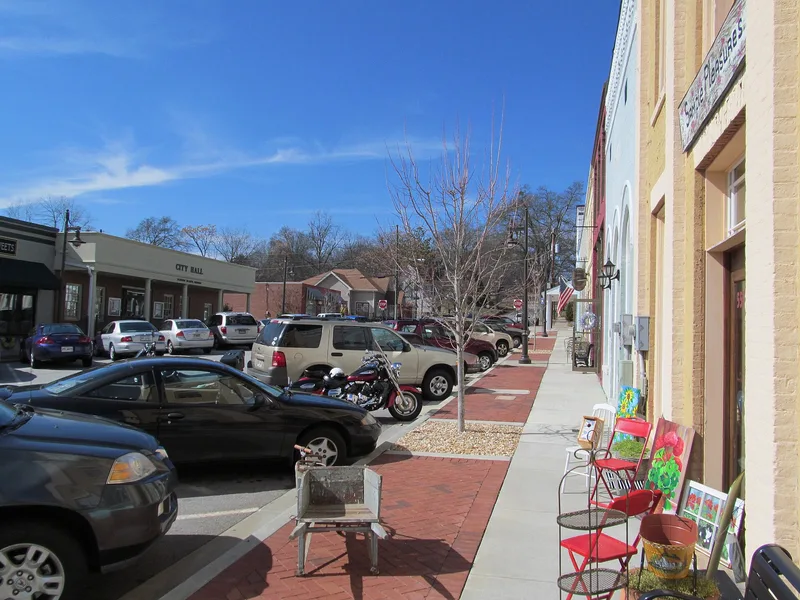
Flowery Branch's central business district is a dense row of one- and two-story commercial buildings along Main Street and Railroad Avenue, built in the late 19th and early 20th centuries. The buildings are attached, set at the sidewalk, and made of brick or rusticated concrete block. Details include corbeled and stepped cornices, metal cornices with floral designs, metal columns, arched windows and brick pilasters. The two-story Carlisle Building, built by farmer Eli Carlisle, has an Italianate entrance with a round-arched lunette window. The district grew after the Richmond and Danville Air-Line Railroad arrived around 1871, and its streets run perpendicular to the tracks, a layout common to railroad towns in Georgia. The town shipped thousands of bales of cotton each year for several northeast Georgia counties. Businesses included hotels, cotton gins, a bank, general stores, a blacksmith shop and later mills and a furniture company. The district was listed for its architecture, commerce, planning and local history, with a significance period of 1871 to 1934.
Machine-generated summary. This summary was generated by a language model from the official nomination document and has not been reviewed line by line by an editor. It may contain errors. Check the source document before relying on any detail. Source: nomination document (PDF) · catalog entry. Generated October 2026 (model claude-sonnet-5-5, prompt v1.0-2026-10-29).
| Period of significance | 1871-1934 |
|---|---|
| Styles | Victorian-eclectic and Italianate |
| Areas of significance | Community Planning and Development, Commerce, Architecture |
| Acreage | 2 |
| Boundary source | NPS cultural-resource GIS polygon |
| Full listing page | Flowery Branch Commercial Historic District (property record) |
What listing means for this property
This is a historic district. Buildings within its boundary are either contributing (they add to the district's significance) or non-contributing. Owners of contributing income-producing buildings can claim the 20% federal rehabilitation tax credit; homeowners should look at state credits. National Register districts impose no design review by themselves; a local historic district ordinance, if one exists, does (the difference explained).
General information, not legal or tax advice. Rules change; confirm with your State Historic Preservation Office or a qualified adviser.