Elder's Mill Covered Bridge and Elder Mill

The National Park Service has not published a boundary polygon for this district; the map shows the listed properties inside it and the district's reference point.
Why it's listed
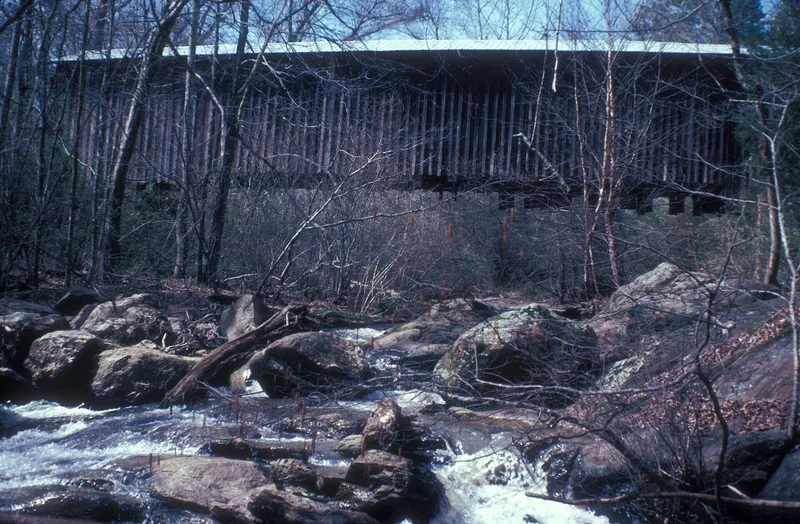
Elder's Mill Covered Bridge and Elder Mill form a small rural complex southeast of Watkinsville, Georgia. The 99-foot wooden bridge was built in 1897 by Nathaniel Richardson using the Town Lattice truss, originally crossing Call Creek in Clarke County. In 1924 it was taken apart, hauled by wagon, and rebuilt over Rose Creek in Oconee County, where it took its name from the neighboring mill. The c. 1900 mill is a three-story wood-frame building that used a turbine to grind wheat and corn for local farmers until 1941. Much of its original machinery remains, including the millstone, sifters, and wood chutes. The property was recognized for the bridge's engineering and its role in Georgia's early road system, for the mill's plain, utilitarian design and its place in rural industry, and for the rare survival of a mill and covered bridge together. Only one other such pairing remains intact in the state.
Machine-generated summary. This summary was generated by a language model from the official nomination document and has not been reviewed line by line by an editor. It may contain errors. Check the source document before relying on any detail. Source: nomination document (PDF) · catalog entry. Generated October 2026 (model claude-sonnet-5-5, prompt v1.0-2026-10-29).
| Period of significance | 1897-1941 |
|---|---|
| Styles | OTHER: Functional |
| Areas of significance | Transportation, Industry, Engineering, Architecture |
| Acreage | 6 |
| Boundary source | not published |
| Full listing page | Elder's Mill Covered Bridge and Elder Mill (property record) |
What listing means for this property
This is a historic district. Buildings within its boundary are either contributing (they add to the district's significance) or non-contributing. Owners of contributing income-producing buildings can claim the 20% federal rehabilitation tax credit; homeowners should look at state credits. National Register districts impose no design review by themselves; a local historic district ordinance, if one exists, does (the difference explained).
General information, not legal or tax advice. Rules change; confirm with your State Historic Preservation Office or a qualified adviser.