Downtown Winder Historic District

The National Park Service has not published a boundary polygon for this district; the map shows the listed properties inside it and the district's reference point.
Why it's listed
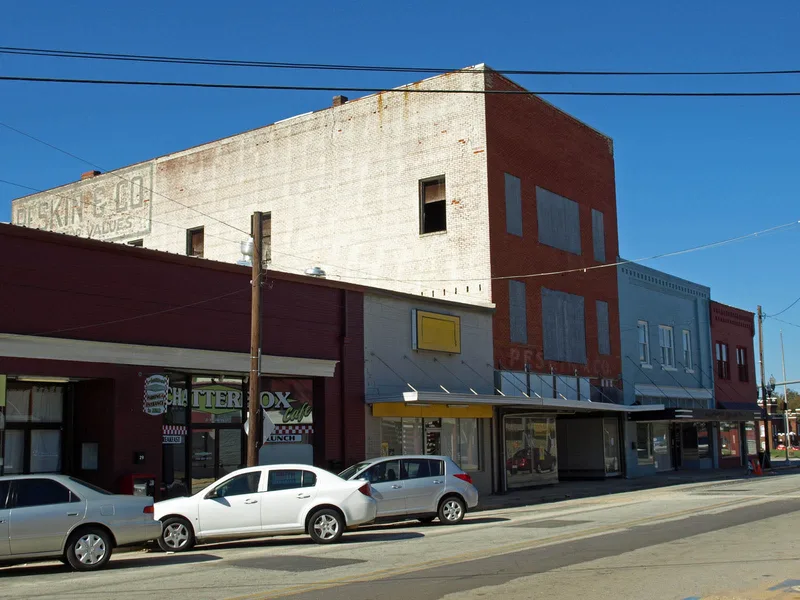
Downtown Winder's historic district covers roughly eight blocks of the central business district in Winder, the Barrow County seat. It combines two earlier listed commercial districts, along Broad and Jackson Streets, with surrounding blocks that had not been documented before. Most of its 44 contributing buildings are attached one- and two-story brick commercial structures set flush to the sidewalk, built between the 1890s and 1942. Notable buildings include the 1920 Neoclassical Revival courthouse and 1916 Late Gothic Revival jail, both designed by James J. Baldwin, the granite-faced Granite Hotel, and the Sharpton Opera House above a commercial space. The town grew after the Gainesville-Midland Railroad arrived in 1884 and the Seaboard Air Line followed in 1892. Warehouses, a wholesale grocery, a lumber company and a 1930 gas station show the area's industrial and automobile-related commerce. The courthouse lawn serves as the community's open space and gathering place. The district is significant locally for architecture, commerce, landscape architecture, government and transportation.
Machine-generated summary. This summary was generated by a language model from the official nomination document and has not been reviewed line by line by an editor. It may contain errors. Check the source document before relying on any detail. Source: nomination document (PDF) · catalog entry. Generated October 2026 (model claude-sonnet-5-5, prompt v1.0-2026-10-29).
| Period of significance | 1884-1942 |
|---|---|
| Styles | Late Gothic Revival; Neoclassical Revival; 20th-Century Commercial |
| Areas of significance | Architecture, Commerce, Transportation |
| Acreage | 9.5 |
| Boundary source | not published |
| Full listing page | Downtown Winder Historic District (property record) |
What listing means for this property
This is a historic district. Buildings within its boundary are either contributing (they add to the district's significance) or non-contributing. Owners of contributing income-producing buildings can claim the 20% federal rehabilitation tax credit; homeowners should look at state credits. National Register districts impose no design review by themselves; a local historic district ordinance, if one exists, does (the difference explained).
General information, not legal or tax advice. Rules change; confirm with your State Historic Preservation Office or a qualified adviser.