Dickey-Birdsong Plantation

Why it's listed
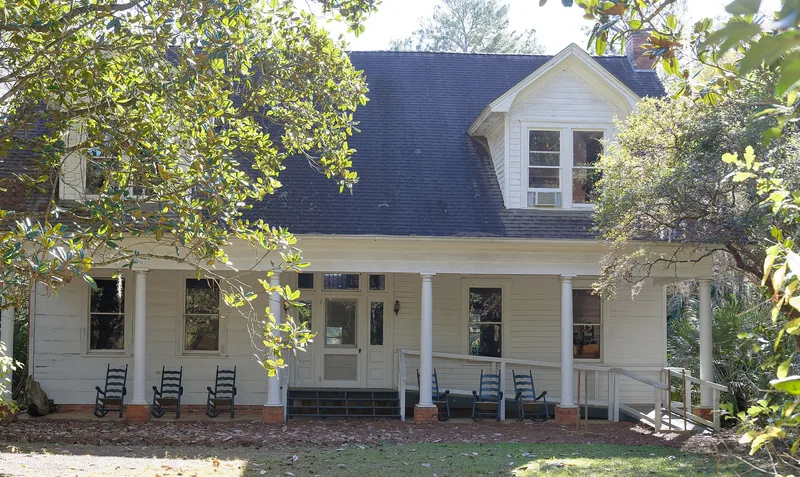
Dickey-Birdsong Plantation is a 565-acre rural property near the Georgia-Florida line in Grady County. Its core is a frame, one-and-one-half-story house finished in 1912 by enlarging a mid-19th century dogtrot, using heart pine cut on the land. Nearby stand an 1858 barn, a pump house, a cow shed and other frame outbuildings, along with five historic fields, a 1910 pecan orchard and a champion pecan tree planted in the 1850s. The Dickey family acquired the land between 1836 and 1872 and farmed it until 1938, growing cotton, corn, sugar cane and rice, and later relying on tenant farmers. William Dickey's journals describe daily plantation work. In 1938 Edwin and Betty Komarek took over and managed the land for wildlife, creating ponds, swamp and varied habitats. Since the 1980s part of it has served as the Birdsong Nature Center, where visitors watch birds from a large window added in 1958.
Machine-generated summary. This summary was generated by a language model from the official nomination document and has not been reviewed line by line by an editor. It may contain errors. Check the source document before relying on any detail. Source: nomination document (PDF) · catalog entry. Generated October 2026 (model claude-sonnet-5-5, prompt v1.0-2026-10-29).
| Styles | Neoclassical Revival |
|---|---|
| Areas of significance | Conservation, Agriculture, Architecture |
| Acreage | 565 |
| Boundary source | NPS cultural-resource GIS polygon |
| Full listing page | Dickey-Birdsong Plantation (property record) |
What listing means for this property
This is a historic district. Buildings within its boundary are either contributing (they add to the district's significance) or non-contributing. Owners of contributing income-producing buildings can claim the 20% federal rehabilitation tax credit; homeowners should look at state credits. National Register districts impose no design review by themselves; a local historic district ordinance, if one exists, does (the difference explained).
General information, not legal or tax advice. Rules change; confirm with your State Historic Preservation Office or a qualified adviser.