Berry Schools

Why it's listed
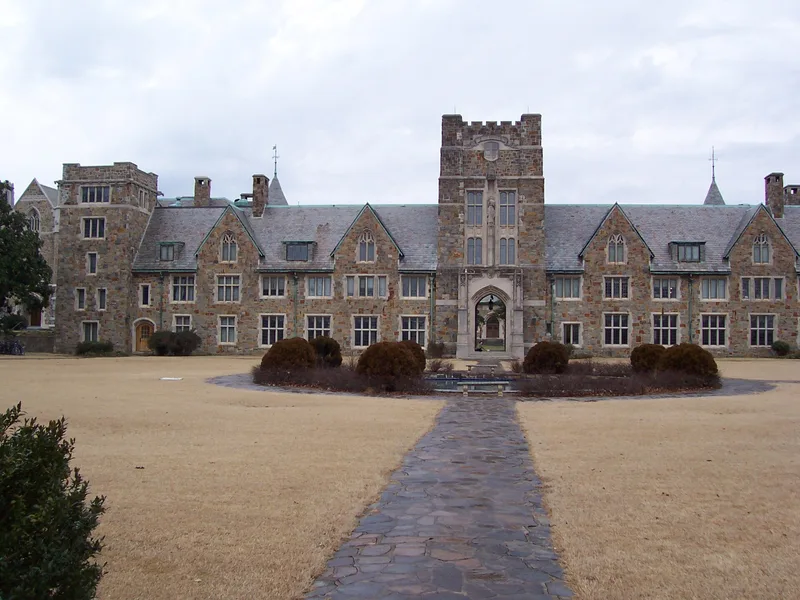
Berry Schools Historic District near Rome, Georgia, covers about 5,300 acres of a 30,000-acre holding, mostly forest. It includes the Berry College campus, the Berry Academy campus, a wooded corridor known as The Stretch, Oak Hill (Martha Berry's family home, built in 1847), the House o' Dreams, a mill and waterwheel, and Possum Trot Church. Martha Berry began teaching Sunday School to mountain children around 1900, opened a boys' school in 1902 and a girls' school in 1909, and added a college program in 1926. Students paid little or nothing in cash but worked rotating shifts, and they built most of the campus from logs cut on the property and bricks they made. The buildings range from log cabins to a Collegiate Gothic women's residence group and coursed stone dormitories. The district was listed for its role in educating thousands of students through a work-based model.
Machine-generated summary. This summary was generated by a language model from the official nomination document and has not been reviewed line by line by an editor. It may contain errors. Check the source document before relying on any detail. Source: nomination document (PDF) · catalog entry. Generated October 2026 (model claude-sonnet-5-5, prompt v1.0-2026-10-29).
| Period of significance | 1900- |
|---|---|
| Styles | Classical, log, Collegiate Gothic, coursed stone |
| Areas of significance | Agriculture, Conservation, Education, Architecture, Religion, Social History |
| Acreage | 5300 |
| Boundary source | NPS cultural-resource GIS polygon |
| Full listing page | Berry Schools (property record) |
What listing means for this property
This is a historic district. Buildings within its boundary are either contributing (they add to the district's significance) or non-contributing. Owners of contributing income-producing buildings can claim the 20% federal rehabilitation tax credit; homeowners should look at state credits. National Register districts impose no design review by themselves; a local historic district ordinance, if one exists, does (the difference explained).
General information, not legal or tax advice. Rules change; confirm with your State Historic Preservation Office or a qualified adviser.