Uptown Tenderloin Historic District

The National Park Service has not published a boundary polygon for this district; the map shows the listed properties inside it and the district's reference point.
Why it's listed
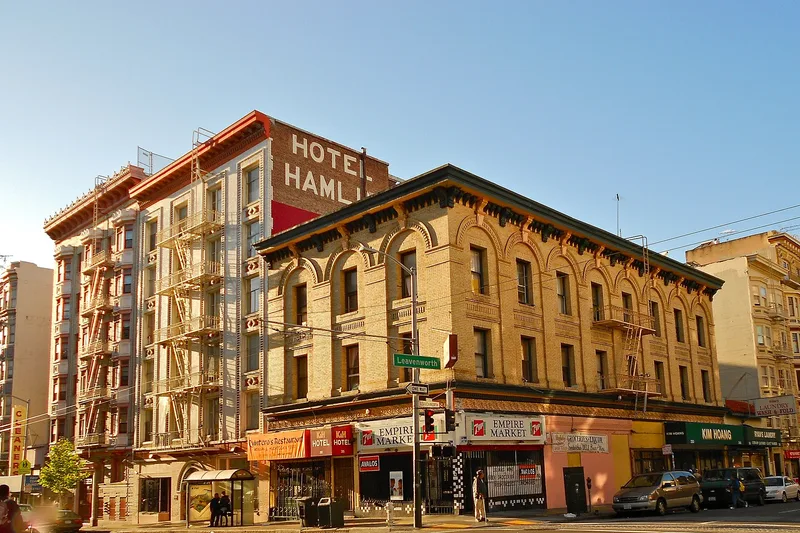
Covering all or part of 33 blocks west of Market Street in San Francisco, this district is a dense neighborhood of 3- to 7-story hotels, apartments and apartment-hotels. Nearly all of it was built between the 1906 earthquake and fire and the early 1930s. After the disaster destroyed the area's wood houses and flats, new fire-limit rules required brick or reinforced-concrete exterior walls, which raised building costs and encouraged larger, higher-income buildings. A limited number of architects, builders and clients produced a harmonious streetscape, with buildings rising straight from the sidewalk and decorated with galvanized iron, terra cotta, and brick. Most ornament reflects an eclectic Beaux Arts approach, while some buildings follow Tudor, Spanish Colonial or Italian Renaissance revival styles. Churches, stores, garages, a YMCA complex, a bathhouse, union halls and film exchanges are mixed among the residences. The district was recognized for its social history and architecture, and it keeps a high degree of integrity for the period 1906-1931. Three of its buildings were already individually listed.
Machine-generated summary. This summary was generated by a language model from the official nomination document and has not been reviewed line by line by an editor. It may contain errors. Check the source document before relying on any detail. Source: nomination document (PDF) · catalog entry. Generated October 2026 (model claude-sonnet-5-5, prompt v1.0-2026-10-29).
| Period of significance | 1906-1957 |
|---|---|
| Styles | Late 19th and 20th century revivals (Beaux Arts, Colonial Revival, Classical Revival, Tudor Revival, Spanish Colonial Revival, Italian Renaissance, French Renaissance), Skyscraper, Moderne |
| Areas of significance | Architecture, Social History |
| Acreage | 110 |
| Boundary source | not published |
| Full listing page | Uptown Tenderloin Historic District (property record) |
What listing means for this property
This is a historic district. Buildings within its boundary are either contributing (they add to the district's significance) or non-contributing. Owners of contributing income-producing buildings can claim the 20% federal rehabilitation tax credit; homeowners should look at state credits. National Register districts impose no design review by themselves; a local historic district ordinance, if one exists, does (the difference explained).
General information, not legal or tax advice. Rules change; confirm with your State Historic Preservation Office or a qualified adviser.