Twentieth Street Historic District

The National Park Service has not published a boundary polygon for this district; the map shows the listed properties inside it and the district's reference point.
Why it's listed
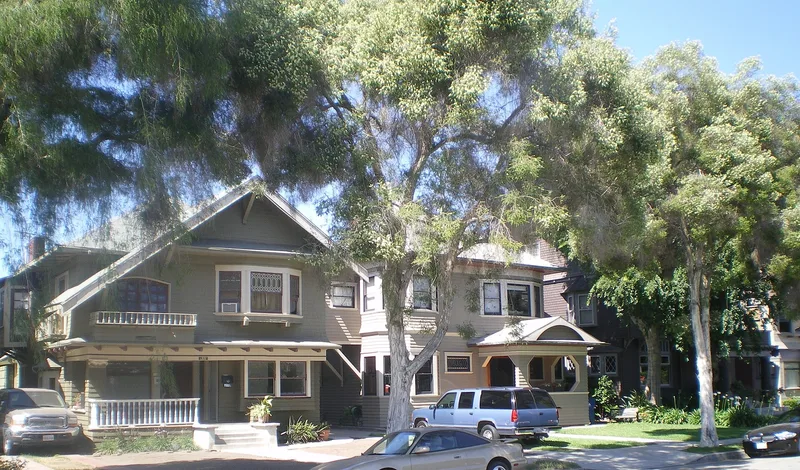
Ten houses line the south side of the 900 block of West 20th Street in the West Adams neighborhood of Los Angeles, close to downtown. Businessman and builder W. Wayman Watts constructed them between about 1902 and 1908, working in a partnership with George Steckel. Most are two-story frame homes clad in wood shingle and clapboard, with similar setbacks and roof heights. Several follow a Chalet-Craftsman pattern, while others include a rare Prairie Style bungalow and two Transitional Victorian designs. Each house differs subtly in plan and decoration, yet the block reads as a cohesive streetscape. The homes were developed for upper-middle-class families during the peak of West Adams' fashionability, and the block was the last major subdivision in the area north of Adams Boulevard and east of Hoover Street. It is the only known residential subdivision by Watts. Much of the surrounding neighborhood has seen demolition and alteration, which makes this intact row stand out.
Machine-generated summary. This summary was generated by a language model from the official nomination document and has not been reviewed line by line by an editor. It may contain errors. Check the source document before relying on any detail. Source: nomination document (PDF) · catalog entry. Generated October 2026 (model claude-sonnet-5-5, prompt v1.0-2026-10-29).
| Period of significance | 1903-1908 |
|---|---|
| Styles | Bungalow/Craftsman (Craftsman/Late Shingle Style, including Chalet-Craftsman, Prairie Style and Transitional Victorian examples) |
| Areas of significance | Architecture |
| Acreage | 3 |
| Boundary source | not published |
| Full listing page | Twentieth Street Historic District (property record) |
What listing means for this property
This is a historic district. Buildings within its boundary are either contributing (they add to the district's significance) or non-contributing. Owners of contributing income-producing buildings can claim the 20% federal rehabilitation tax credit; homeowners should look at state credits. National Register districts impose no design review by themselves; a local historic district ordinance, if one exists, does (the difference explained).
General information, not legal or tax advice. Rules change; confirm with your State Historic Preservation Office or a qualified adviser.