St. Andrews Bungalow Court

The National Park Service has not published a boundary polygon for this district; the map shows the listed properties inside it and the district's reference point.
Why it's listed
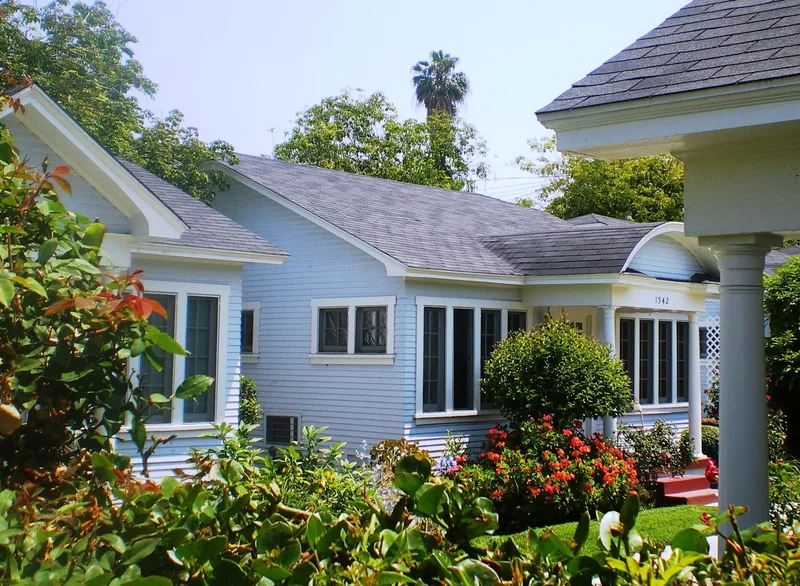
Fifteen small Colonial Revival bungalows face one another across a landscaped central court at 1514-1544 N. St. Andrews Place in Hollywood. Built in 1919 and 1920 for Fay Sudrow as a rental investment, the complex has fourteen single-family units and a rear duplex on an unusually large 100-by-250-foot lot. Each wood-frame bungalow has clipped gable roofs, beveled siding and a front porch with Tuscan columns, and there are nine distinct gable treatments. The court is a good example of a housing type that spread across Hollywood between 1910 and 1930 as the film industry drew new residents, though many such courts have since been lost to development. No architect is named; the work was done by builders. After abandonment in 1989 and vandalism, a nonprofit developer rehabilitated the property in 1995, repairing siding, windows, doors and cabinetry. It remains in residential use and was recognized for its architecture, its size and its individually detailed units.
Machine-generated summary. This summary was generated by a language model from the official nomination document and has not been reviewed line by line by an editor. It may contain errors. Check the source document before relying on any detail. Source: nomination document (PDF) · catalog entry. Generated October 2026 (model claude-sonnet-5-5, prompt v1.0-2026-10-29).
| Period of significance | 1919-1920 |
|---|---|
| Styles | Colonial Revival |
| Areas of significance | Architecture |
| Acreage | 0.9 |
| Boundary source | not published |
| Full listing page | St. Andrews Bungalow Court (property record) |
What listing means for this property
This is a historic district. Buildings within its boundary are either contributing (they add to the district's significance) or non-contributing. Owners of contributing income-producing buildings can claim the 20% federal rehabilitation tax credit; homeowners should look at state credits. National Register districts impose no design review by themselves; a local historic district ordinance, if one exists, does (the difference explained).
General information, not legal or tax advice. Rules change; confirm with your State Historic Preservation Office or a qualified adviser.