Sonoma Plaza (Boundary Increase)

The National Park Service has not published a boundary polygon for this district; the map shows the listed properties inside it and the district's reference point.
Why it's listed
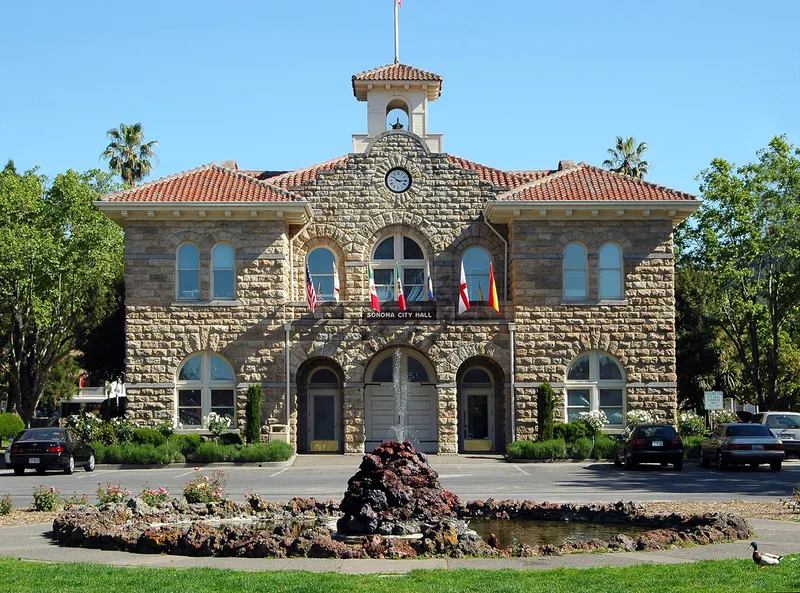
Sonoma Plaza and its surrounding blocks form a historic district in Sonoma, California, with a large, flat, tree-filled plaza at the center and a grid of streets extending outward. Commercial buildings of one to four stories face the plaza, while the side streets are mostly one-story houses. Buildings date from the 1830s to the 1930s and include adobes, Italianate storefronts, Queen Anne and Eastlake houses, bungalows, and Mission Revival structures. The plaza was once a Mexican-era parade ground and later gained Bear Flag monuments, the 1906 City Hall, a 1910 Carnegie Library, a duck pond and extensive plantings. The district also includes the Mission San Francisco Solano site, the Casa Grande site and the Swiss and Toscano hotels. The period of significance runs from 1835 to 1944. Few high-rise or modern intrusions exist, and most changes are low-rise construction or replaced windows. The district keeps the character of a small country town center, and the boundary increase adds areas along Broadway and East Napa Street.
Machine-generated summary. This summary was generated by a language model from the official nomination document and has not been reviewed line by line by an editor. It may contain errors. Check the source document before relying on any detail. Source: nomination document (PDF) · catalog entry. Generated October 2026 (model claude-sonnet-5-5, prompt v1.0-2026-10-29).
| Period of significance | 1835-1944 |
|---|---|
| Styles | Mid-19th Century California Monterey Colonial; Late Victorian (Queen Anne, Eastlake); Beaux Arts, Mission and Spanish Colonial Revival; Bungalow |
| Areas of significance | Community Planning and Development, Commerce, Architecture |
| Acreage | 2 |
| Boundary source | not published |
| Full listing page | Sonoma Plaza (Boundary Increase) (property record) |
What listing means for this property
This is a historic district. Buildings within its boundary are either contributing (they add to the district's significance) or non-contributing. Owners of contributing income-producing buildings can claim the 20% federal rehabilitation tax credit; homeowners should look at state credits. National Register districts impose no design review by themselves; a local historic district ordinance, if one exists, does (the difference explained).
General information, not legal or tax advice. Rules change; confirm with your State Historic Preservation Office or a qualified adviser.