San Jose Downtown Historic District

Why it's listed
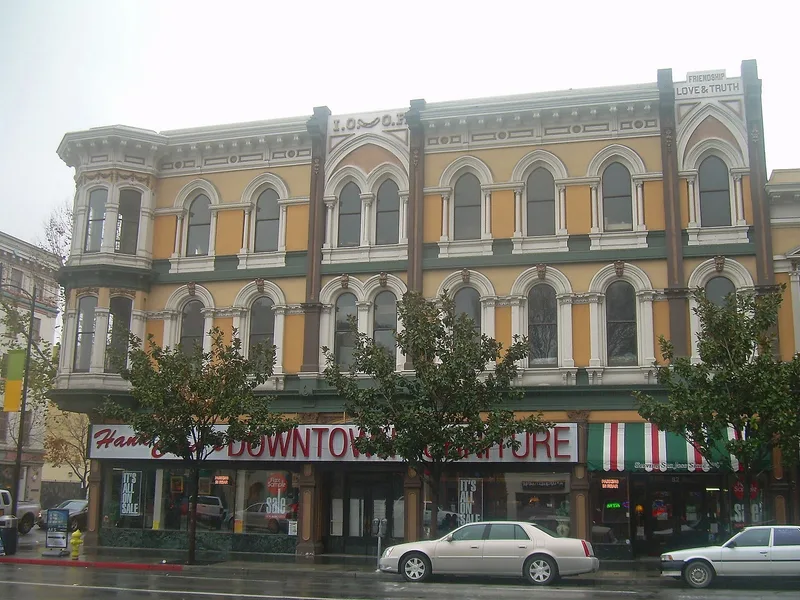
Two blocks of downtown San Jose make up this commercial district, bounded roughly by East Santa Clara Street, East San Fernando Street, and South First and Third Streets. Its buildings range from the 1870s to the early 1940s and show how the city's business core changed over time. The Italianate Oddfellows Building of 1883 is the best surviving example from the 1870s and 1880s. Romanesque buildings along South First Street, including the Knox-Goodrich, Letitia and Security buildings, reflect the orchard-era prosperity of the 1890s and were designed by local architects such as Levi Goodrich and Jacob Lenzen. After the 1906 earthquake, Edwardian, Mission Revival and Spanish Colonial Revival buildings appeared, followed by Moderne designs in the 1930s and 1940s. The 1926 Bank of America Building, San Jose's first skyscraper, anchors the district. Parking lots and altered buildings are counted as non-contributing, but the historic buildings remain the dominant presence. The district was recognized as the county's best concentration of varied commercial architecture.
Machine-generated summary. This summary was generated by a language model from the official nomination document and has not been reviewed line by line by an editor. It may contain errors. Check the source document before relying on any detail. Source: nomination document (PDF) · catalog entry. Generated October 2026 (model claude-sonnet-5-5, prompt v1.0-2026-10-29).
| Styles | Mixed commercial styles including Italianate, Richardsonian and Romanesque Revival, Edwardian, Mission and Spanish Colonial Revival, Renaissance detailing, and Moderne |
|---|---|
| Areas of significance | Commerce, Architecture |
| Acreage | 0.4 |
| Boundary source | NPS cultural-resource GIS polygon |
| Full listing page | San Jose Downtown Historic District (property record) |
What listing means for this property
This is a historic district. Buildings within its boundary are either contributing (they add to the district's significance) or non-contributing. Owners of contributing income-producing buildings can claim the 20% federal rehabilitation tax credit; homeowners should look at state credits. National Register districts impose no design review by themselves; a local historic district ordinance, if one exists, does (the difference explained).
General information, not legal or tax advice. Rules change; confirm with your State Historic Preservation Office or a qualified adviser.