Richmond Shipyard Number Three

Why it's listed
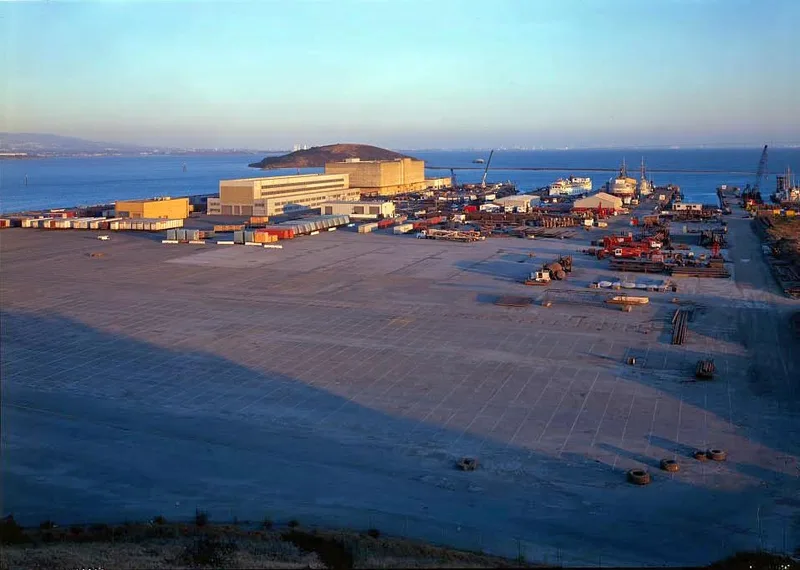
Shipyard Number Three occupies the tip of Potrero Point in Richmond, California, on roughly 140 acres bounded on three sides by San Francisco Bay. Ground was broken in January 1942, after about 2.2 million cubic yards of rock and earth were moved to level the point. It was one of four Kaiser shipyards in Richmond and is now the only substantially intact one. Surviving elements include five concrete basins, the General Warehouse, Machine Shop, Sheet Metal Shop, Forge Shop, Cafeteria and First Aid Station. The General Warehouse, a four-story Streamlined Moderne concrete building, was built in 120 days. Unlike the sloping ways of the other yards, the level basins eased hull assembly, and the yard's spacing supported prefabrication and straight-line production. Ships left the basins about 85 percent complete. Most other original buildings have been demolished. The yard was declared surplus in 1946 and remained a ship repair and storage facility, which is why it is recognized for advances in shipyard design and ship construction.
Machine-generated summary. This summary was generated by a language model from the official nomination document and has not been reviewed line by line by an editor. It may contain errors. Check the source document before relying on any detail. Source: nomination document (PDF) · catalog entry. Generated October 2026 (model claude-sonnet-5-5, prompt v1.0-2026-10-29).
| Styles | Streamlined Moderne; Industrial Vernacular |
|---|---|
| Areas of significance | Maritime History, Engineering, Military |
| Acreage | 70 |
| Boundary source | NPS cultural-resource GIS polygon |
| Full listing page | Richmond Shipyard Number Three (property record) |
What listing means for this property
This is a historic district. Buildings within its boundary are either contributing (they add to the district's significance) or non-contributing. Owners of contributing income-producing buildings can claim the 20% federal rehabilitation tax credit; homeowners should look at state credits. National Register districts impose no design review by themselves; a local historic district ordinance, if one exists, does (the difference explained).
General information, not legal or tax advice. Rules change; confirm with your State Historic Preservation Office or a qualified adviser.