Raymond-Summit Historic District

Why it's listed
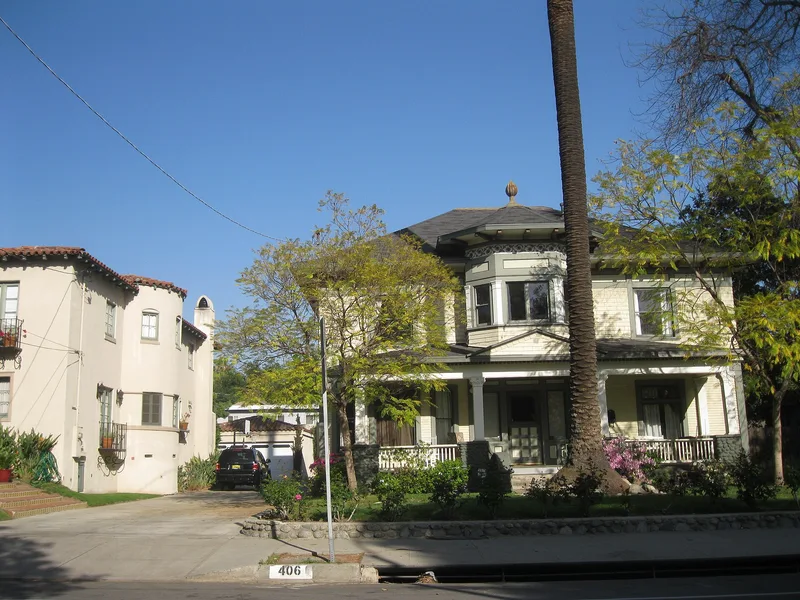
Located in Pasadena, this residential district centers on North Raymond Avenue and Summit Avenue, with East Villa Street and East Maple Street forming other edges. It contains 22 contributing and 27 noncontributing buildings, mostly houses built between about 1890 and 1905. Styles include Queen Anne, Folk Victorian, American Foursquare, Colonial Revival and vernacular hipped and gabled cottages. Typical lots have a one or two-story main house set behind a landscaped yard, a concrete driveway at one side, and a newer garage or extra dwelling at the rear. Mature street trees line the blocks, and several front yards have Canary Island date palms. Architects represented include Charles W. Buchanan and the early firm of Greene & Greene, whose 1897 shingle-style house stands on Raymond Avenue. The district is one of three Pasadena neighborhoods with intact groups of late 19th and early 20th century homes, and its houses are generally larger and more elaborate than those in the other two, having been built for wealthier clients. Despite alterations, it keeps the feel of a middle-class neighborhood of that era.
Machine-generated summary. This summary was generated by a language model from the official nomination document and has not been reviewed line by line by an editor. It may contain errors. Check the source document before relying on any detail. Source: nomination document (PDF) · catalog entry. Generated October 2026 (model claude-sonnet-5-5, prompt v1.0-2026-10-29).
| Styles | Late Victorian (Queen Anne, Folk Victorian, American Foursquare, Vernacular Gabled and Hipped Cottage); Late 19th and 20th Century Revivals (Colonial Revival) |
|---|---|
| Areas of significance | Architecture, Exploration/Settlement |
| Acreage | 4.6 |
| Boundary source | NPS cultural-resource GIS polygon |
| Full listing page | Raymond-Summit Historic District (property record) |
What listing means for this property
This is a historic district. Buildings within its boundary are either contributing (they add to the district's significance) or non-contributing. Owners of contributing income-producing buildings can claim the 20% federal rehabilitation tax credit; homeowners should look at state credits. National Register districts impose no design review by themselves; a local historic district ordinance, if one exists, does (the difference explained).
General information, not legal or tax advice. Rules change; confirm with your State Historic Preservation Office or a qualified adviser.