Ramona Street Architectural District

The National Park Service has not published a boundary polygon for this district; the map shows the listed properties inside it and the district's reference point.
Why it's listed
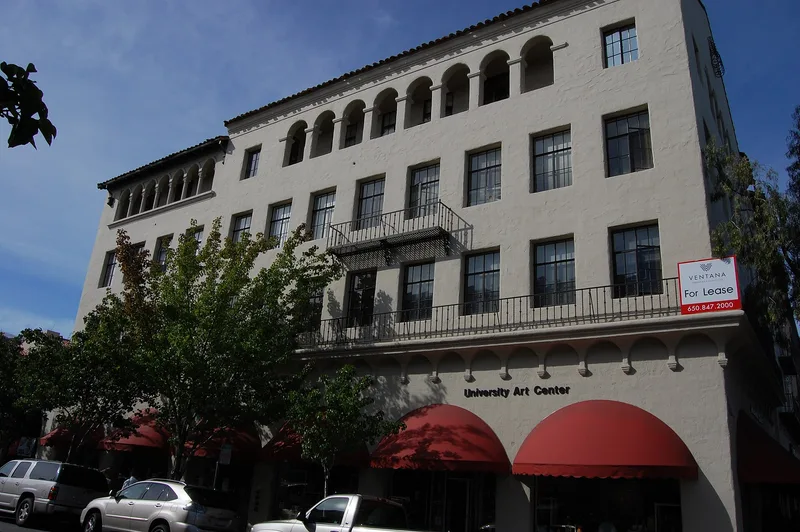
Ramona Street in downtown Palo Alto holds a compact group of eight commercial buildings put up between 1924 and 1938, just south of University Avenue. Their heights run from one to four stories, and they share stucco walls in muted colors, Spanish tile roofs, arches, balconies, wrought iron and decorative glazed tile. Most are Monterey Colonial or Spanish Colonial Revival, with Craftsman woodwork in several interiors and exteriors. Designer Pedro de Lemos and architects Birge Clark and William H. Weeks created the buildings, some for specific tenants such as a dress shop, a savings and loan and a men's clothing store, and others for the Palo Alto Improvement Company. The Cardinal Hotel, with its classical details, is the one stylistic exception, yet it balances the four-story Medico-Dental building at the corner of Hamilton Avenue. The district was recognized for its unified character, the absence of intrusions and the sensitive handling of later changes, giving the block the feel of a Spanish village.
Machine-generated summary. This summary was generated by a language model from the official nomination document and has not been reviewed line by line by an editor. It may contain errors. Check the source document before relying on any detail. Source: nomination document (PDF) · catalog entry. Generated October 2026 (model claude-sonnet-5-5, prompt v1.0-2026-10-29).
| Period of significance | 1924-1938 |
|---|---|
| Styles | Monterey Colonial and Spanish Colonial Revival, with Craftsman details; the Cardinal Hotel has Classic/Neo-Classical elements |
| Areas of significance | Community Planning and Development, Architecture |
| Acreage | 0.2 |
| Boundary source | not published |
| Full listing page | Ramona Street Architectural District (property record) |
What listing means for this property
This is a historic district. Buildings within its boundary are either contributing (they add to the district's significance) or non-contributing. Owners of contributing income-producing buildings can claim the 20% federal rehabilitation tax credit; homeowners should look at state credits. National Register districts impose no design review by themselves; a local historic district ordinance, if one exists, does (the difference explained).
General information, not legal or tax advice. Rules change; confirm with your State Historic Preservation Office or a qualified adviser.