Point Cabrillo Light Station

Why it's listed
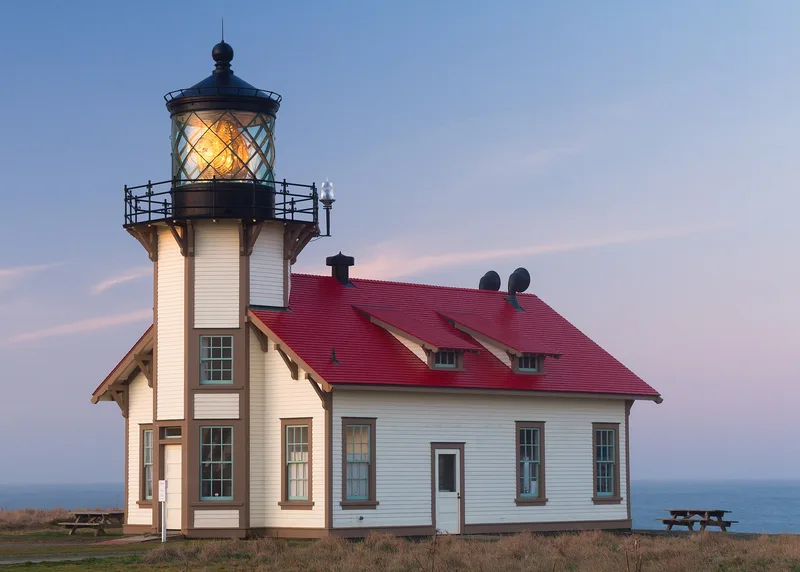
Point Cabrillo Light Station occupies a grassy mesa about 60 feet above the Pacific near Caspar, in Mendocino County. Its first light shone on June 10, 1909, filling a 115-mile gap in coastal lighting between Point Arena and Cape Mendocino. Small lumber schooners hugging the shore to reach the narrow doghole ports relied on it. The station is laid out in a line running inland from the cliffs, led by a wood tower attached to a fog-signal building that resembles a church with a steeple. Behind it stand three two-story Craftsman keepers' houses, an oil house, a carpenter's shop, storage buildings, a pump house and a water tank. The tower still holds its original 3rd order Fresnel lens. Only the barn from the original station is gone, and no modern buildings intrude. The station was recognized for its link to the timber economy and maritime transportation, and for its remarkably complete early 20th century architecture, including massive timber brackets and wood shingle siding.
Machine-generated summary. This summary was generated by a language model from the official nomination document and has not been reviewed line by line by an editor. It may contain errors. Check the source document before relying on any detail. Source: nomination document (PDF) · catalog entry. Generated October 2026 (model claude-sonnet-5-5, prompt v1.0-2026-10-29).
| Period of significance | 1909-1940 |
|---|---|
| Styles | Bungalow/Craftsman |
| Areas of significance | Commerce, Transportation, Architecture, Maritime History |
| Acreage | 30.4 |
| Boundary source | NPS cultural-resource GIS polygon |
| Full listing page | Point Cabrillo Light Station (property record) |
What listing means for this property
This is a historic district. Buildings within its boundary are either contributing (they add to the district's significance) or non-contributing. Owners of contributing income-producing buildings can claim the 20% federal rehabilitation tax credit; homeowners should look at state credits. National Register districts impose no design review by themselves; a local historic district ordinance, if one exists, does (the difference explained).
General information, not legal or tax advice. Rules change; confirm with your State Historic Preservation Office or a qualified adviser.