North Harper Avenue Historic District

The National Park Service has not published a boundary polygon for this district; the map shows the listed properties inside it and the district's reference point.
Why it's listed
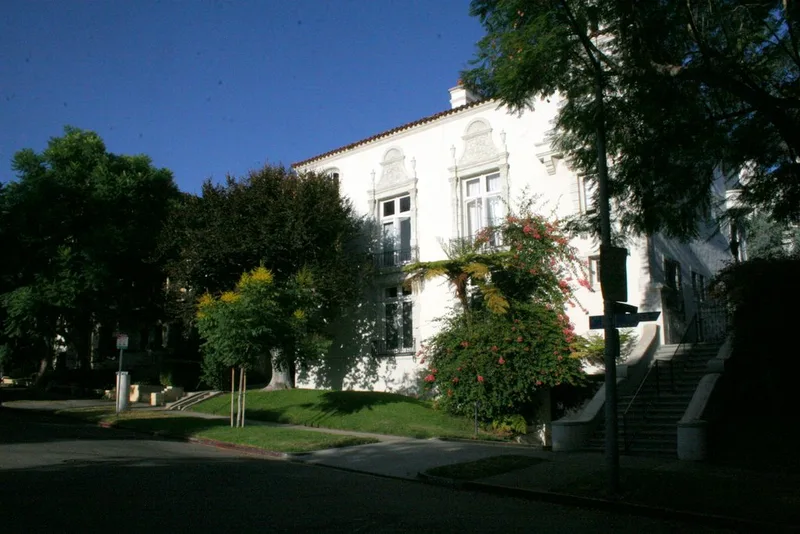
This West Hollywood district groups apartment buildings along North Harper Avenue and the north side of Fountain Avenue. Eight contributing apartment buildings and a garage with an attached dwelling were built between 1923 and 1931. They range from one to four stories and fill most of their lots, with towers, courtyards, balconies and landscaping. Styles include Spanish Colonial Revival, Mediterranean Revival and Chateauesque. Mexican Village (1923) was the first of the group. Patio del Moro (1925) has Moorish detailing and is also listed individually. Les Maisonettes (1927) is Chateauesque and has a detached garage. Leland A. Bryant designed several of the buildings, and Arthur and Nina Zwebell designed Mexican Village and Patio del Moro. The surrounding area was mostly single-family houses in the period of significance and is now dense with later apartments. The nomination describes this cluster as the only grouping of its kind in West Hollywood. Two newer apartment buildings do not contribute but are said not to detract from the district's character.
Machine-generated summary. This summary was generated by a language model from the official nomination document and has not been reviewed line by line by an editor. It may contain errors. Check the source document before relying on any detail. Source: nomination document (PDF) · catalog entry. Generated October 2026 (model claude-sonnet-5-5, prompt v1.0-2026-10-29).
| Styles | Late 19th and 20th Century Revivals: Spanish/Colonial Revival, Mediterranean Revival, Chateauesque, Monterey Revival |
|---|---|
| Areas of significance | Architecture |
| Acreage | 3 |
| Boundary source | not published |
| Full listing page | North Harper Avenue Historic District (property record) |
What listing means for this property
This is a historic district. Buildings within its boundary are either contributing (they add to the district's significance) or non-contributing. Owners of contributing income-producing buildings can claim the 20% federal rehabilitation tax credit; homeowners should look at state credits. National Register districts impose no design review by themselves; a local historic district ordinance, if one exists, does (the difference explained).
General information, not legal or tax advice. Rules change; confirm with your State Historic Preservation Office or a qualified adviser.