Mission Court Bungalows

The National Park Service has not published a boundary polygon for this district; the map shows the listed properties inside it and the district's reference point.
Why it's listed
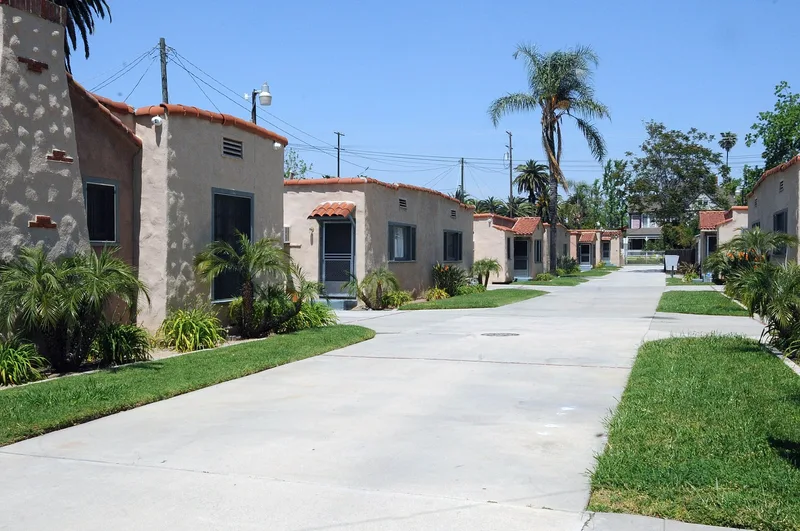
Mission Court Bungalows is a bungalow court in Riverside, California, set in the middle of a block and open to both First and Second Streets through a central drive. Walter R. Goss, a local contractor, built it between 1927 and 1931. It holds four duplexes and five single residences, with 13 living units and one small garage or storage building. Walls are textured stucco over wood frame, and the roofs are tile or asphalt. The design mixes Spanish Colonial Revival, Mission Revival and Pueblo elements, with curved walls, arched openings and many-paned windows. The court has changed little, and mature trees, bushes and grass still fill the grounds. Its importance lies in its form as a bungalow court, a housing type that offered attractive, affordable, dense living around a shared setting. Few such courts were built in Riverside, and only three of an estimated eight survive. It was recognized for that rarity and its intact layout.
Machine-generated summary. This summary was generated by a language model from the official nomination document and has not been reviewed line by line by an editor. It may contain errors. Check the source document before relying on any detail. Source: nomination document (PDF) · catalog entry. Generated October 2026 (model claude-sonnet-5-5, prompt v1.0-2026-10-29).
| Period of significance | 1927 - 1931 |
|---|---|
| Styles | Late 19th and 20th Century Revivals: Mission/Spanish Colonial Revival and Pueblo |
| Areas of significance | Architecture |
| Acreage | 0.7 |
| Boundary source | not published |
| Full listing page | Mission Court Bungalows (property record) |
What listing means for this property
This is a historic district. Buildings within its boundary are either contributing (they add to the district's significance) or non-contributing. Owners of contributing income-producing buildings can claim the 20% federal rehabilitation tax credit; homeowners should look at state credits. National Register districts impose no design review by themselves; a local historic district ordinance, if one exists, does (the difference explained).
General information, not legal or tax advice. Rules change; confirm with your State Historic Preservation Office or a qualified adviser.