Mentor Court

The National Park Service has not published a boundary polygon for this district; the map shows the listed properties inside it and the district's reference point.
Why it's listed
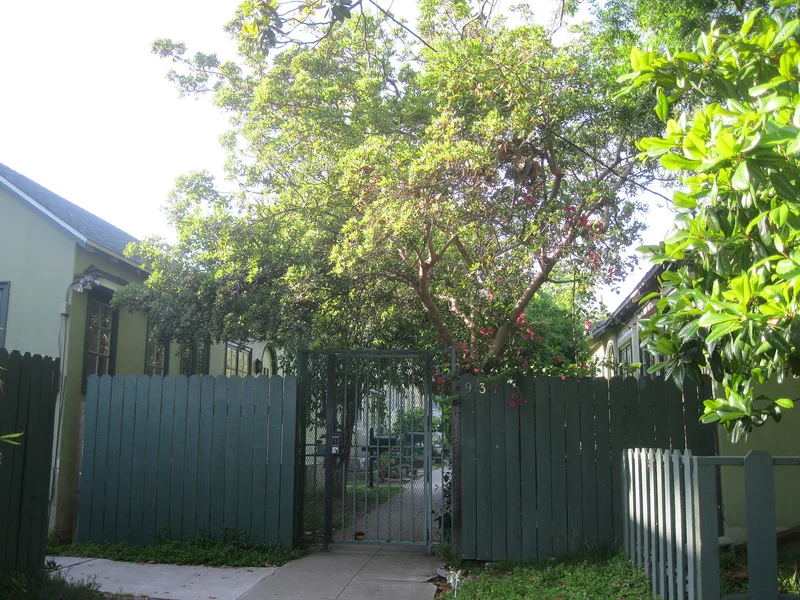
Mentor Court is a 1923 bungalow court on a narrow 60-foot-wide lot at 937 East California Boulevard in Pasadena. Eleven housing units are arranged in a U-shaped layout around a central concrete walkway, with a single bungalow at the far end and two small sheds flanking it. The buildings include two triplexes, two duplexes and the single cottage, all in the English Cottage Revival style, with stucco walls, jerkinhead roofs, eyebrow hoods over the entrances, arched wood doors and wood casement windows. Ivy, shrubs, lawns and mature trees give the grounds a village-like feel. Built by the Delux Building company, the court was listed for its architecture as one of the best Pasadena examples of the enclosed narrow bungalow court. Its combination of single, duplex and triplex buildings is rarely found in such courts. Later wrought iron railings and two replaced windows are the main alterations, and they do not greatly reduce its integrity.
Machine-generated summary. This summary was generated by a language model from the official nomination document and has not been reviewed line by line by an editor. It may contain errors. Check the source document before relying on any detail. Source: nomination document (PDF) · catalog entry. Generated October 2026 (model claude-sonnet-5-5, prompt v1.0-2026-10-29).
| Period of significance | 1923 |
|---|---|
| Styles | Other: English Cottage Revival |
| Areas of significance | Architecture |
| Acreage | 0.9 |
| Boundary source | not published |
| Full listing page | Mentor Court (property record) |
What listing means for this property
This is a historic district. Buildings within its boundary are either contributing (they add to the district's significance) or non-contributing. Owners of contributing income-producing buildings can claim the 20% federal rehabilitation tax credit; homeowners should look at state credits. National Register districts impose no design review by themselves; a local historic district ordinance, if one exists, does (the difference explained).
General information, not legal or tax advice. Rules change; confirm with your State Historic Preservation Office or a qualified adviser.