Menlo Avenue-West Twenty-ninth Street Historic District

Why it's listed
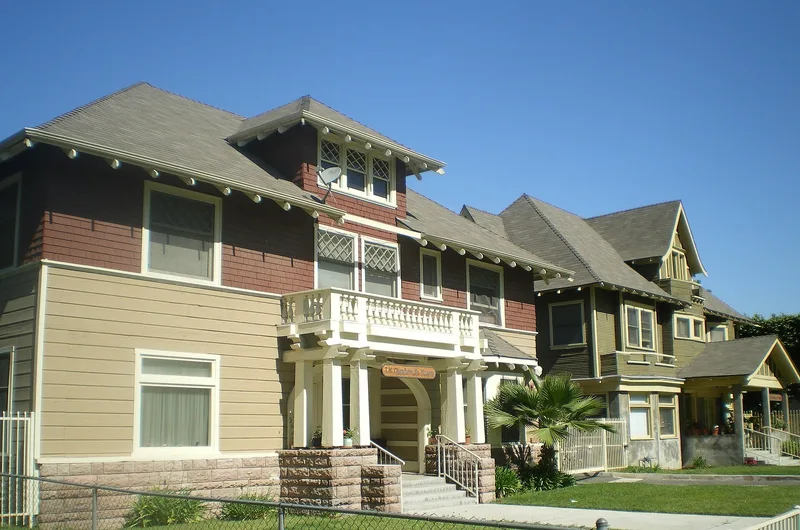
Menlo Avenue and West 29th Street in North University Park, Los Angeles, hold a district of 42 building sites, most of them large houses from the turn of the twentieth century. Thirty are counted as contributing, all built between 1896 and 1908, and they show Queen Anne, Shingle, Colonial Revival, Tudor Revival, Craftsman and Classical Revival influences. The houses are wood frame, nearly all two to two and a half stories, and many keep scrollwork pediments, bracketed eaves, corbelled brick chimneys and shingle patterning. Edwin Rowley built several of them for resale, and architects Sumner P. Hunt and Wesley Eager designed the Crombie House. Early residents included businessmen, a physician and a girls' school. Over time many houses were divided into flats, some were damaged by fire or altered with siding and porch enclosures, and several were later restored. Nearby streets have lost most of their older homes to apartment buildings, which makes this block an unusually cohesive survivor.
Machine-generated summary. This summary was generated by a language model from the official nomination document and has not been reviewed line by line by an editor. It may contain errors. Check the source document before relying on any detail. Source: nomination document (PDF) · catalog entry. Generated October 2026 (model claude-sonnet-5-5, prompt v1.0-2026-10-29).
| Styles | Queen Anne, Shingle, Colonial Revival, Tudor Revival, Craftsman and Classical Revival |
|---|---|
| Areas of significance | Exploration/Settlement, Architecture |
| Acreage | 11 |
| Boundary source | NPS cultural-resource GIS polygon |
| Full listing page | Menlo Avenue-West Twenty-ninth Street Historic District (property record) |
What listing means for this property
This is a historic district. Buildings within its boundary are either contributing (they add to the district's significance) or non-contributing. Owners of contributing income-producing buildings can claim the 20% federal rehabilitation tax credit; homeowners should look at state credits. National Register districts impose no design review by themselves; a local historic district ordinance, if one exists, does (the difference explained).
General information, not legal or tax advice. Rules change; confirm with your State Historic Preservation Office or a qualified adviser.