Mary Louise Court

The National Park Service has not published a boundary polygon for this district; the map shows the listed properties inside it and the district's reference point.
Why it's listed
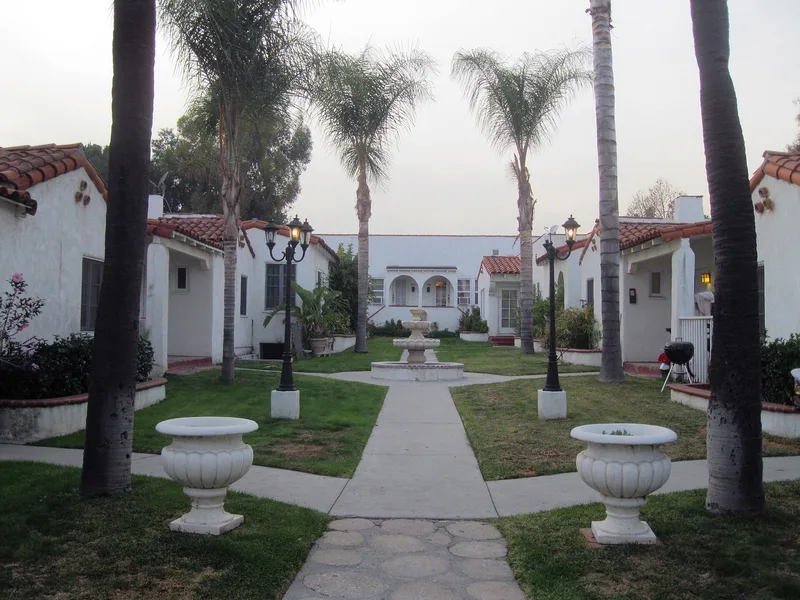
Mary Louise Court is a 1928 bungalow court at 583-599 North Mentor Avenue in Pasadena. Seven wood-frame, stucco-clad buildings are arranged in a U shape on a lot 117 feet wide and 191 feet deep. A rear structure holds four units, two middle buildings hold three units each, and four front buildings contain single units. Varied building sizes, an irregular stone path and palm trees, including Mexican Fan Palms, give the court the feel of a small village. Arched porches, tiled roofs, stucco walls and stone detailing evoke an affordable Southern California version of Mediterranean living. Robert Harris, the original owner, is listed on the building permits as architect and contractor. The court was listed for its architecture. It is considered one of the best Pasadena examples of the bungalow court form and an outstanding Spanish Colonial Revival example. It remains in excellent condition with few alterations, such as screen doors and window air conditioners.
Machine-generated summary. This summary was generated by a language model from the official nomination document and has not been reviewed line by line by an editor. It may contain errors. Check the source document before relying on any detail. Source: nomination document (PDF) · catalog entry. Generated October 2026 (model claude-sonnet-5-5, prompt v1.0-2026-10-29).
| Period of significance | 1928 |
|---|---|
| Styles | Spanish Colonial Revival |
| Areas of significance | Architecture |
| Acreage | 0.9 |
| Boundary source | not published |
| Full listing page | Mary Louise Court (property record) |
What listing means for this property
This is a historic district. Buildings within its boundary are either contributing (they add to the district's significance) or non-contributing. Owners of contributing income-producing buildings can claim the 20% federal rehabilitation tax credit; homeowners should look at state credits. National Register districts impose no design review by themselves; a local historic district ordinance, if one exists, does (the difference explained).
General information, not legal or tax advice. Rules change; confirm with your State Historic Preservation Office or a qualified adviser.