Marguerita Lane Historic District

The National Park Service has not published a boundary polygon for this district; the map shows the listed properties inside it and the district's reference point.
Why it's listed
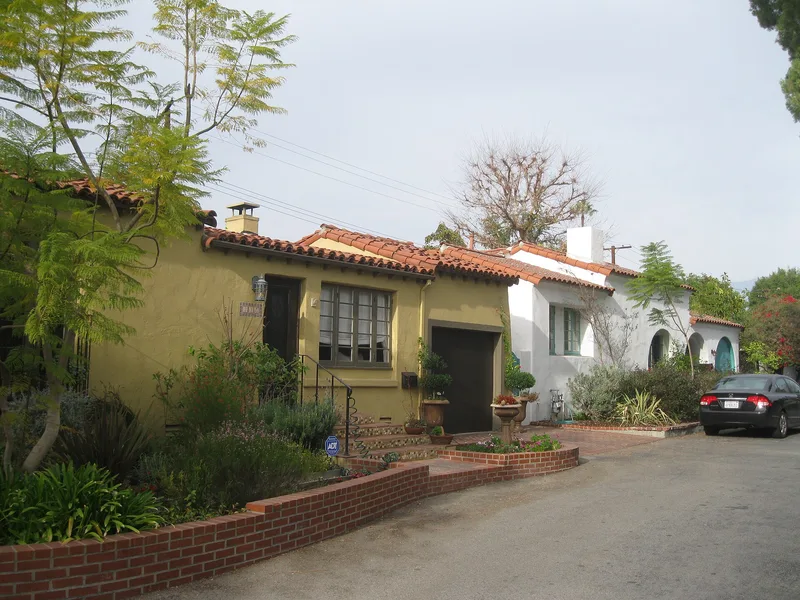
Marguerita Lane is a dead-end private street in southern Pasadena, off South Marengo Avenue, lined with small Spanish Colonial Revival houses. The subdivision was conceived as an artists' colony, and every lot was developed between 1927 and 1930. The houses are mostly one story, between 900 and 1,500 square feet, with wood-framed stucco walls, multi-paned wood casement windows and red clay tile roofs. Each design is unique, yet they share style, scale and materials. Most were designed by the Schutt Brothers or by Denman Schutt, with another by R. E. Nelson. The lane has no streetlights, curbs or sidewalks, and hedges, garden walls and planter strips line its edge. Nineteen resources contribute to the district and four do not, mostly because carports or additions were added to garages or houses. The district is recognized for architecture. Pasadena has many fine Spanish Colonial Revival houses, but this one is notable as a unified group of similar houses on small lots that has changed very little since it was built.
Machine-generated summary. This summary was generated by a language model from the official nomination document and has not been reviewed line by line by an editor. It may contain errors. Check the source document before relying on any detail. Source: nomination document (PDF) · catalog entry. Generated October 2026 (model claude-sonnet-5-5, prompt v1.0-2026-10-29).
| Period of significance | 1927-1930 |
|---|---|
| Styles | Late 19th & Early 20th Century Revivals: Spanish Colonial Revival |
| Areas of significance | Architecture |
| Acreage | 1.7 |
| Boundary source | not published |
| Full listing page | Marguerita Lane Historic District (property record) |
What listing means for this property
This is a historic district. Buildings within its boundary are either contributing (they add to the district's significance) or non-contributing. Owners of contributing income-producing buildings can claim the 20% federal rehabilitation tax credit; homeowners should look at state credits. National Register districts impose no design review by themselves; a local historic district ordinance, if one exists, does (the difference explained).
General information, not legal or tax advice. Rules change; confirm with your State Historic Preservation Office or a qualified adviser.