Harnetiaux Court

The National Park Service has not published a boundary polygon for this district; the map shows the listed properties inside it and the district's reference point.
Why it's listed
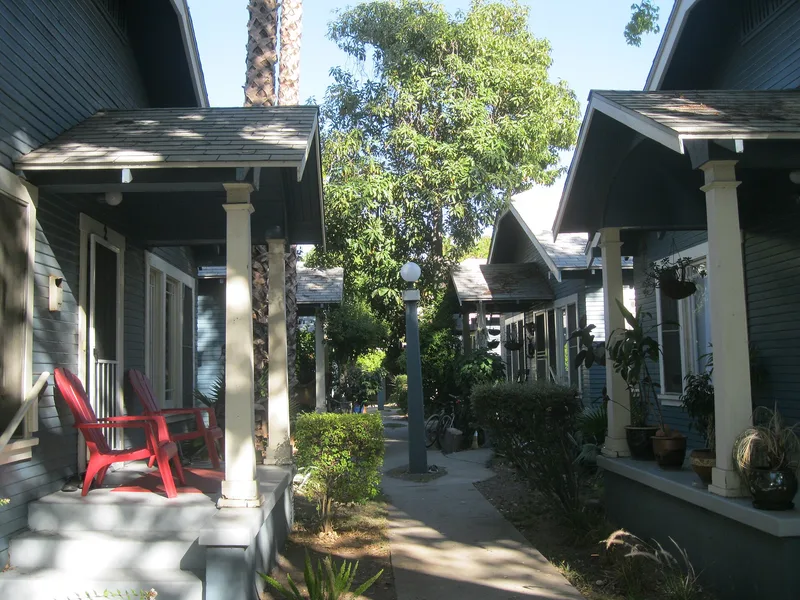
Harnetiaux Court is a bungalow court at 48 North Catalina Avenue in Pasadena, just off Colorado Boulevard. Built in 1922, it groups eight identical wood-frame bungalows and a two-story duplex in a U-shaped layout on a lot 95 feet wide by 182 feet deep. Each bungalow has a jerkinhead roof, a centered columned portico and multi-paned windows. Concrete entry pillars and a tall original light standard mark the central walkway. Joseph Harnetiaux is listed on the building permit as architect, builder and owner, and he built the court with his two brothers and his uncle. The court was listed as one of the best and most intact examples of the bungalow court form in Pasadena. Such courts offered moderate-cost housing near streetcar lines, shops and downtown, balancing privacy with community living. Its Colonial Revival detailing shows how a style once used for mansions reached modest homes. Restoration in 1983 renewed interior features typical of the 1920s.
Machine-generated summary. This summary was generated by a language model from the official nomination document and has not been reviewed line by line by an editor. It may contain errors. Check the source document before relying on any detail. Source: nomination document (PDF) · catalog entry. Generated October 2026 (model claude-sonnet-5-5, prompt v1.0-2026-10-29).
| Period of significance | 1922 |
|---|---|
| Styles | Colonial Revival |
| Areas of significance | Architecture |
| Acreage | 0.9 |
| Boundary source | not published |
| Full listing page | Harnetiaux Court (property record) |
What listing means for this property
This is a historic district. Buildings within its boundary are either contributing (they add to the district's significance) or non-contributing. Owners of contributing income-producing buildings can claim the 20% federal rehabilitation tax credit; homeowners should look at state credits. National Register districts impose no design review by themselves; a local historic district ordinance, if one exists, does (the difference explained).
General information, not legal or tax advice. Rules change; confirm with your State Historic Preservation Office or a qualified adviser.