Grandma Prisbrey's Bottle Village

The National Park Service has not published a boundary polygon for this district; the map shows the listed properties inside it and the district's reference point.
Why it's listed
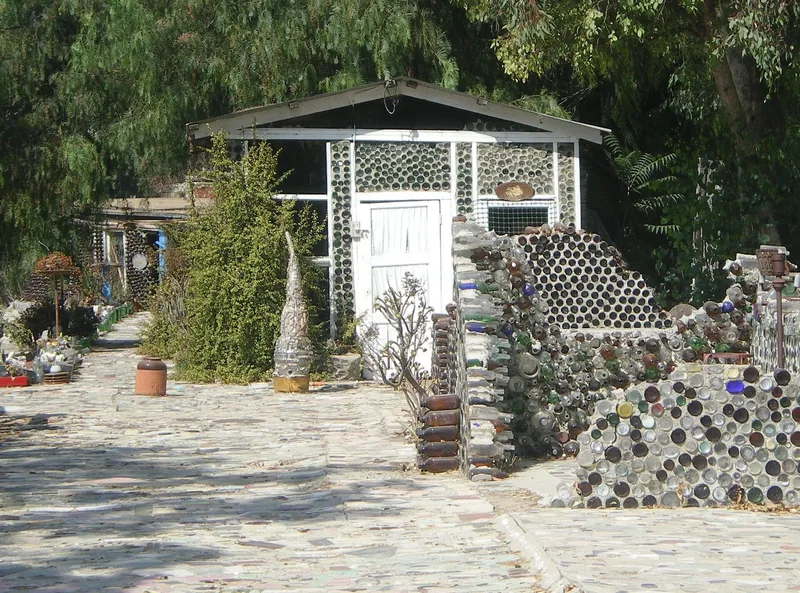
Bottle Village in Simi Valley, California, is a folk art environment on a one-third-acre lot, created by Tressa Prisbrey, who began building at age 60. Between about 1956 and 1960 she assembled 16 one-room structures with walls of thousands of bottles laid in mortar, floors embedded with found objects, and interiors that housed collections of pencils, dolls, shells and shot glasses. Around them she added shrines, wishing wells, walkways and a cactus garden made from car headlights, television tubes and other salvage gathered on her trips to the local dump. She worked almost entirely alone and without formal training in art or construction. The site is valued as an example of bottle-in-mortar construction and as a record of everyday throwaway goods from the late 1950s and early 1960s. The 1994 Northridge earthquake collapsed or badly damaged several structures, leaving eight structures and nine objects as contributing resources.
Machine-generated summary. This summary was generated by a language model from the official nomination document and has not been reviewed line by line by an editor. It may contain errors. Check the source document before relying on any detail. Source: nomination document (PDF) · catalog entry. Generated October 2026 (model claude-sonnet-5-5, prompt v1.0-2026-10-29).
| Styles | Other: Folk Art Environment |
|---|---|
| Areas of significance | Architecture, Art, Landscape Architecture |
| Acreage | 0.3 |
| Boundary source | not published |
| Full listing page | Grandma Prisbrey's Bottle Village (property record) |
What listing means for this property
This is a historic district. Buildings within its boundary are either contributing (they add to the district's significance) or non-contributing. Owners of contributing income-producing buildings can claim the 20% federal rehabilitation tax credit; homeowners should look at state credits. National Register districts impose no design review by themselves; a local historic district ordinance, if one exists, does (the difference explained).
Noted as vacant in the nomination. Nomination documents can be decades old; current status may differ. If you are considering buying an empty listed property, read the due-diligence checklist.
General information, not legal or tax advice. Rules change; confirm with your State Historic Preservation Office or a qualified adviser.