Giant Forest Village-Camp Kaweah Historic District

The National Park Service has not published a boundary polygon for this district; the map shows the listed properties inside it and the district's reference point.
Why it's listed
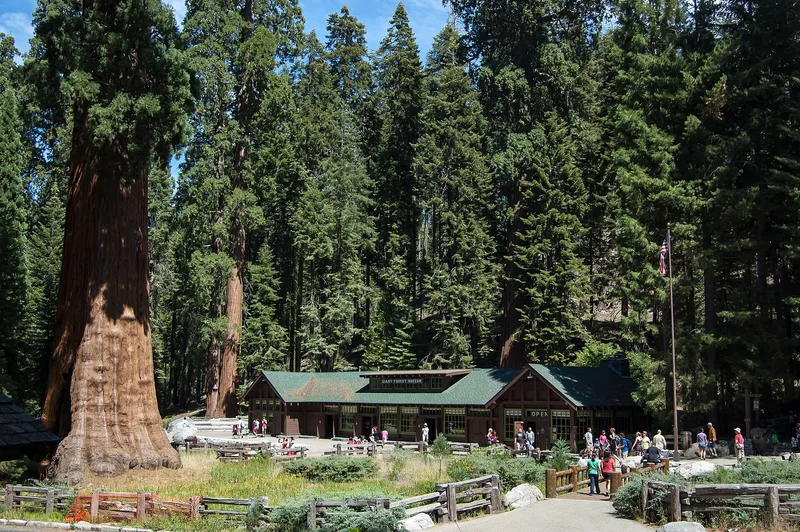
Set among pines, firs and giant sequoias in Sequoia National Park, this district combines a housekeeping cabin camp with three key buildings of Giant Forest Village. Camp Kaweah began in 1926 as a tent camp after the General's Highway opened, and by 1940 its guests stayed in about forty small wooden cabins placed informally along the hillside under National Park Service landscape guidance. In the village, the Giant Forest Market, designed by Gilbert Stanley Underwood and finished in 1929, uses heavy exposed timber framing to match the scale of the trees. A 1931 ranger residence by Merel Sager and a 1932 comfort station show the same effort to keep buildings unobtrusive. The district is valued for its recreational use by California families who spent weeks or whole summers in the cabins, for its design, and for its link to nature writer Sally Carrighar, whose stay in the early 1940s led to her book One Day on Beetle Rock.
Machine-generated summary. This summary was generated by a language model from the official nomination document and has not been reviewed line by line by an editor. It may contain errors. Check the source document before relying on any detail. Source: nomination document (PDF) · catalog entry. Generated October 2026 (model claude-sonnet-5-5, prompt v1.0-2026-10-29).
| Styles | Rustic exposed-frame architecture |
|---|---|
| Areas of significance | Landscape Architecture, Entertainment/Recreation, Literature, Architecture |
| Acreage | 4.2 |
| Boundary source | not published |
| Full listing page | Giant Forest Village-Camp Kaweah Historic District (property record) |
What listing means for this property
This is a historic district. Buildings within its boundary are either contributing (they add to the district's significance) or non-contributing. Owners of contributing income-producing buildings can claim the 20% federal rehabilitation tax credit; homeowners should look at state credits. National Register districts impose no design review by themselves; a local historic district ordinance, if one exists, does (the difference explained).
General information, not legal or tax advice. Rules change; confirm with your State Historic Preservation Office or a qualified adviser.