Generals' Highway Stone Bridges
The National Park Service has not published a boundary polygon for this district; the map shows the listed properties inside it and the district's reference point.
Why it's listed
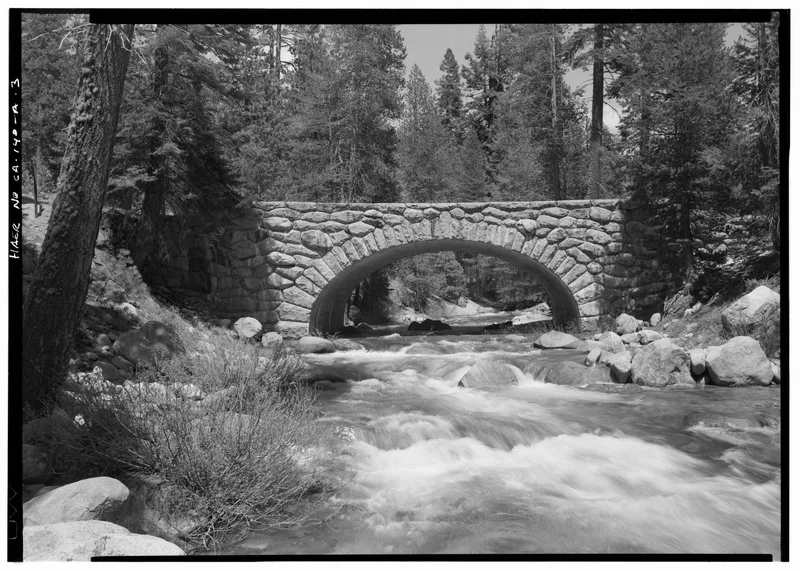
Two stone-faced highway bridges carry the Generals' Highway across the Marble Fork of the Kaweah River and Clover Creek in Sequoia National Park. Built in 1930-1931, each has a reinforced concrete barrel arch hidden behind massive uncoursed masonry. The Marble Fork span measures 45 feet and the Clover Creek span 90 feet, and each carries a 25-foot roadway. John Wosky, a National Park Service landscape architect, designed them after observing bridges with concrete cores and rustic stone exteriors in Westchester County, New York. The goal was to keep road structures from intruding on the landscape. W. A. Bechtel Company won the contract but underestimated costs, and subcontractor C. D. DeVelbiss finished the work in October 1931 using Finnish stone cutters who shaped hard granite into precise blocks. The native stone was chosen to match each setting. The bridges are recognized locally for their architecture, landscape design and craftsmanship, and both remain unaltered and in excellent condition.
Machine-generated summary. This summary was generated by a language model from the official nomination document and has not been reviewed line by line by an editor. It may contain errors. Check the source document before relying on any detail. Source: nomination document (PDF) · catalog entry. Generated October 2026 (model claude-sonnet-5-5, prompt v1.0-2026-10-29).
| Period of significance | 1930-1931 |
|---|---|
| Areas of significance | Landscape Architecture, Architecture |
| Acreage | 1.6 |
| Boundary source | not published |
| Full listing page | Generals' Highway Stone Bridges (property record) |
What listing means for this property
This is a historic district. Buildings within its boundary are either contributing (they add to the district's significance) or non-contributing. Owners of contributing income-producing buildings can claim the 20% federal rehabilitation tax credit; homeowners should look at state credits. National Register districts impose no design review by themselves; a local historic district ordinance, if one exists, does (the difference explained).
General information, not legal or tax advice. Rules change; confirm with your State Historic Preservation Office or a qualified adviser.