Ferndale Main Street Historic District

The National Park Service has not published a boundary polygon for this district; the map shows the listed properties inside it and the district's reference point.
Why it's listed
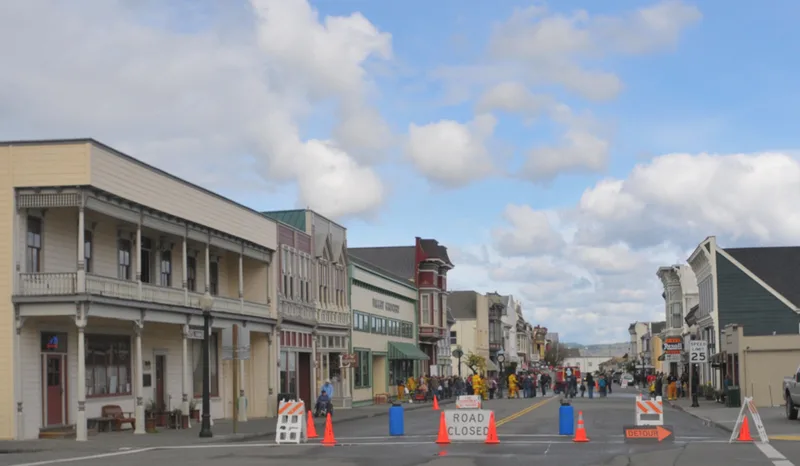
Ferndale's Main Street district is the historic commercial heart of a dairy town in rural Humboldt County, California. The linear four-block area contains 40 contributing and 15 noncontributing resources, mostly one- and two-story false-front commercial buildings with glass storefronts and recessed entrances. Two eras dominate: ornate Late Victorian buildings from 1880 to 1900, including Stick Style works designed by local architect T.J. Frost, and plainer stucco Modernistic and Mission Revival buildings from 1920 to 1936. Examples include the 1877 Alford Drug Store, the 1891 Masonic Temple, the 1911 Ferndale Bank in the Neo-Classical style, and the 1930 Kemp Building. The district is significant because it preserves a coherent, little-altered streetscape, helped by its agricultural setting and limited modern development. Later buildings from the 1940s and 1950s, and Neo-Victorian work of the 1970s, are counted as noncontributing. Contributing buildings are described as in good to excellent condition, and the area remains a business district and visitor draw.
Machine-generated summary. This summary was generated by a language model from the official nomination document and has not been reviewed line by line by an editor. It may contain errors. Check the source document before relying on any detail. Source: nomination document (PDF) · catalog entry. Generated October 2026 (model claude-sonnet-5-5, prompt v1.0-2026-10-29).
| Period of significance | 1877-1943 |
|---|---|
| Styles | Italianate, Stick/Eastlake, Queen Anne, Classical Revival, Mission/Spanish Colonial Revival, Bungalow/Craftsman, Moderne, false front |
| Areas of significance | Commerce, Architecture |
| Acreage | 4.6 |
| Boundary source | not published |
| Full listing page | Ferndale Main Street Historic District (property record) |
What listing means for this property
This is a historic district. Buildings within its boundary are either contributing (they add to the district's significance) or non-contributing. Owners of contributing income-producing buildings can claim the 20% federal rehabilitation tax credit; homeowners should look at state credits. National Register districts impose no design review by themselves; a local historic district ordinance, if one exists, does (the difference explained).
General information, not legal or tax advice. Rules change; confirm with your State Historic Preservation Office or a qualified adviser.