Doheny Estate/Greystone

Why it's listed
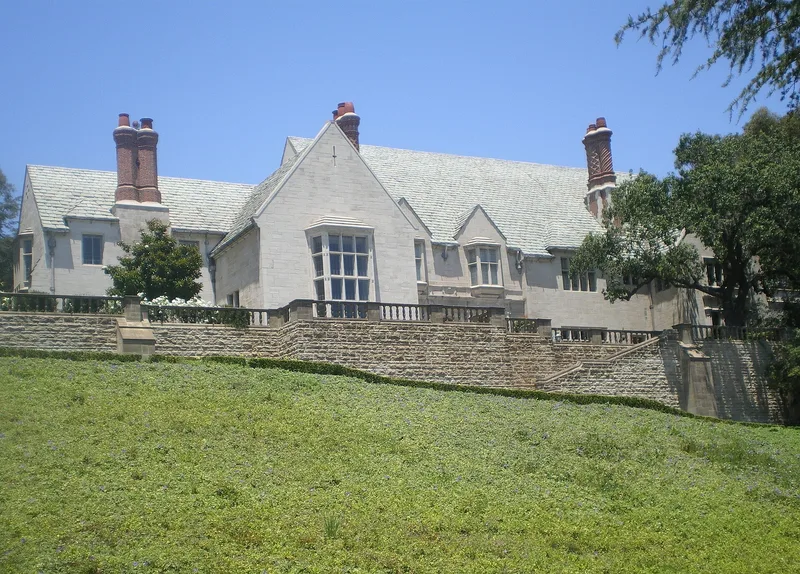
Greystone is an 18.6-acre estate in Beverly Hills, now a city park, built between 1925 and 1929 for Edward L. Doheny Jr. by his father, an oil magnate. Architect Gordon B. Kaufmann designed the 55-room mansion, and P.J. Walker Co. built it at a cost of about four million dollars. Its three-foot-thick Indiana limestone walls, Welsh slate roof, and steel frame reinforced with concrete support interiors of Italian marble, carved oak and walnut, a theatre and bowling alleys. The style is described as Early Los Angeles Baronial, mixing Gothic, English and Italian forms. The grounds hold a firehouse, stables, garages, a greenhouse, a gatehouse and sixteen acres of formal gardens with fountains and sculpture. The Doheny family lived here until 1955, and citizens later saved it from subdivision. The city purchased it in 1964. The American Film Institute leases the mansion for its film studies center, and concerts and theatre take place on the grounds.
Machine-generated summary. This summary was generated by a language model from the official nomination document and has not been reviewed line by line by an editor. It may contain errors. Check the source document before relying on any detail. Source: nomination document (PDF) · catalog entry. Generated October 2026 (model claude-sonnet-5-5, prompt v1.0-2026-10-29).
| Period of significance | Built from 1925-29 |
|---|---|
| Styles | Early Los Angeles Baronial, with Gothic, English and Italian elements |
| Areas of significance | Art, Architecture |
| Acreage | 18.6 |
| Boundary source | NPS cultural-resource GIS polygon |
| Full listing page | Doheny Estate/Greystone (property record) |
What listing means for this property
This is a historic district. Buildings within its boundary are either contributing (they add to the district's significance) or non-contributing. Owners of contributing income-producing buildings can claim the 20% federal rehabilitation tax credit; homeowners should look at state credits. National Register districts impose no design review by themselves; a local historic district ordinance, if one exists, does (the difference explained).
General information, not legal or tax advice. Rules change; confirm with your State Historic Preservation Office or a qualified adviser.